📌 Summary & Key Takeaways
- Shorter Horizons Support Higher Withdrawal Rates: Historical decumulation backtests of a 100% S&P 500 equity portfolio allocation (0% bonds) from 1928 to 2025 demonstrate a 99.8% survival rate at a 4.5% SWR over 15 years (994 of 996 monthly cohorts survived), a 99.3% survival rate at 7.0% SWR over 10 years (1049 of 1056 cohorts), and a 96.1% survival rate at 8.0% SWR over 10 years (1015 of 1056 cohorts).
- The SWR Duration Curve Is Steeply Non-Linear: Extending retirement from 10 to 20 years forces a noticeable reduction in safe withdrawal rates (from 7.0%+ down to 4.5%), but expanding from 20 to 30 years adds far less incremental risk once a portfolio survives the early sequence-of-returns window.
- 100% Equity Exposure Is Behaviorally Viable for Short Bridges: For 15-year or shorter bridge retirements, historical backtests show an all-stock portfolio allocation supported higher withdrawal rates with near-zero ruin events — proving that duration, rather than asset mix alone, dictates market volatility tolerance.
How Long Is Retirement?
30 Years?
A 30-year retirement horizon is the standard benchmark in financial planning. The logic assumes retirees leave the workforce around age 65 when eligible for Medicare and full Social Security. According to Social Security Administration (SSA) actuarial tables, approximately 1 in 7 65-year-olds (14%) live past age 95.
Why Might Your Horizon Be Shorter?
- Bridge Retirements: You are using personal portfolio capital as a temporary 10-to-15-year bridge until Social Security, pensions, or annuity payouts activate.
- Late Workforce Exit: You retired later in life (e.g., age 70–75) with lower total years in retirement.
- Health Circumstances: You have a reduced life expectancy due to medical history or terminal illness.
This Is Part Three — Read Parts One & Two First
If you haven’t read my prior analysis on SWR Fundamentals and Safe Withdrawal Rate Failures, read those first. They cover the core simulation architecture, return distributions, and decumulation mechanics referenced below.
Simulation Architecture
To evaluate how retirement length alters portfolio survival, I ran two complementary simulation models:
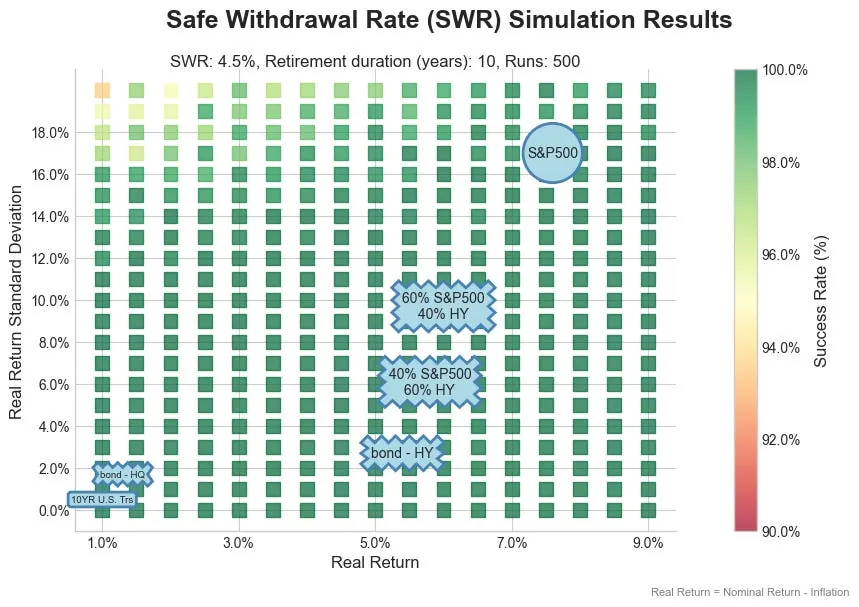
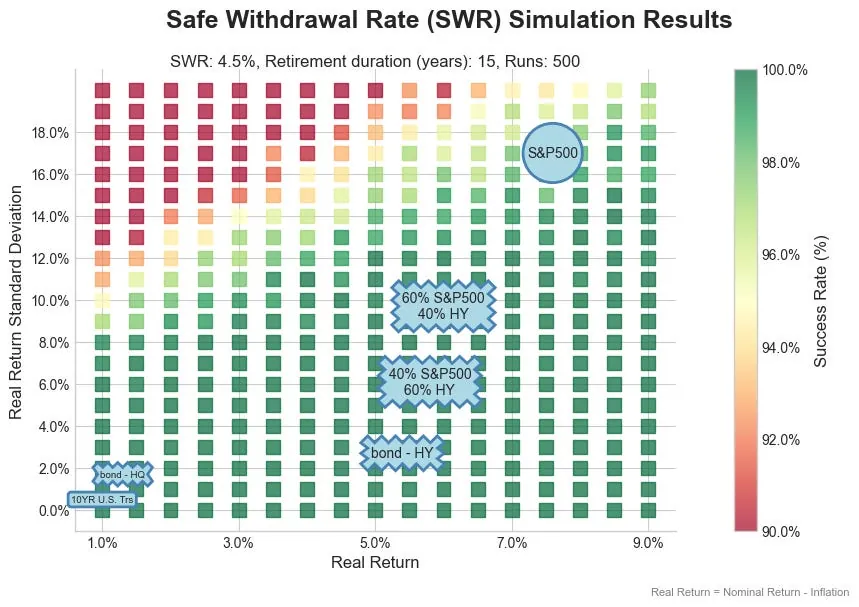
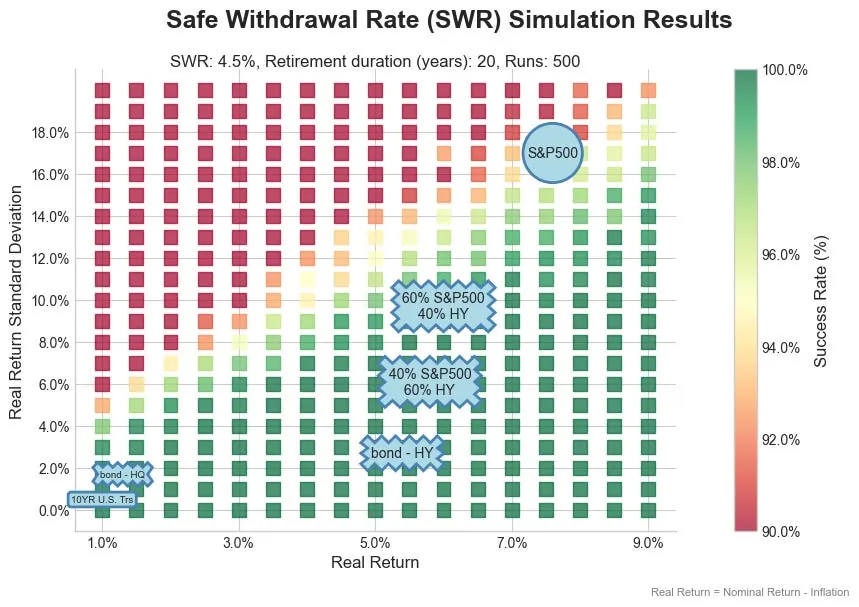
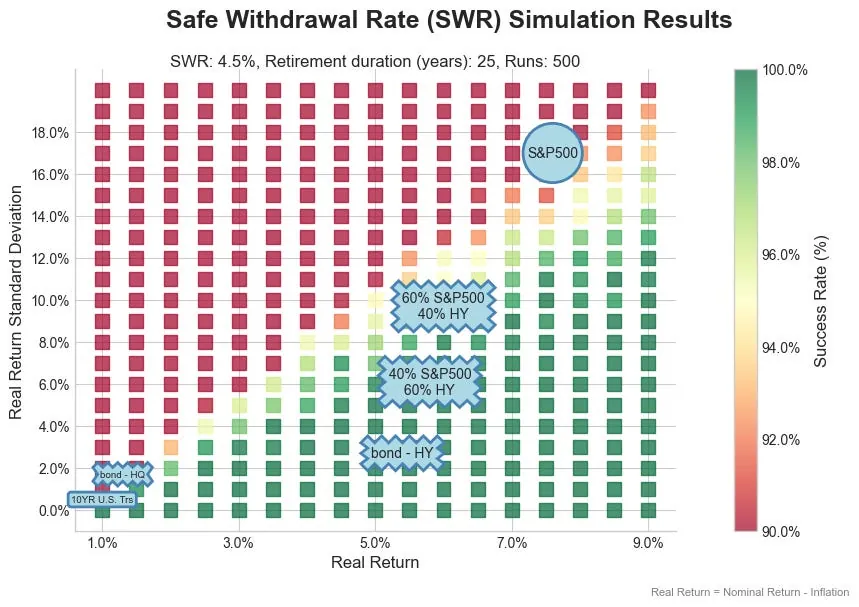
- Parametric Volatility Heatmaps: Monte Carlo sweeps testing Real Return (1% to 9%) versus Volatility (1% to 20% StDev) across 10, 15, 20, and 25-year retirement durations.
- Historical Market Sweeps: Rolling monthly decumulation backtests of a 100% S&P 500 equity portfolio allocation (0% bonds) from 1928 to 2025 across 10-year, 15-year, and 20-year horizons (with 20-year 4.5% SWR and 10-year 8.0% SWR stress tests rendered in detailed multi-panel charts below).
Heatmaps for a 4.5% SWR Across 10, 15, 20, and 25-Year Horizons
Key Insights from the 4.5% SWR Sweeps
- 10 to 15-Year Horizons: The green zone (representing 95%+ survival rates) covers nearly the entire return/volatility grid. Higher volatility carries minimal failure risk over shorter spans.
- 20 to 25-Year Horizons: As duration extends past 15 years, portfolios with high equity volatility (StDev > 15%) begin encountering sequence-of-returns failure drag unless real returns exceed 5%.
Because a 4.5% SWR proved almost bulletproof over short windows, I tested higher 6.0% and 7.0% withdrawal rates over 10-year and 15-year durations.
Heatmaps for 6.0% and 7.0% SWR over Short Horizons
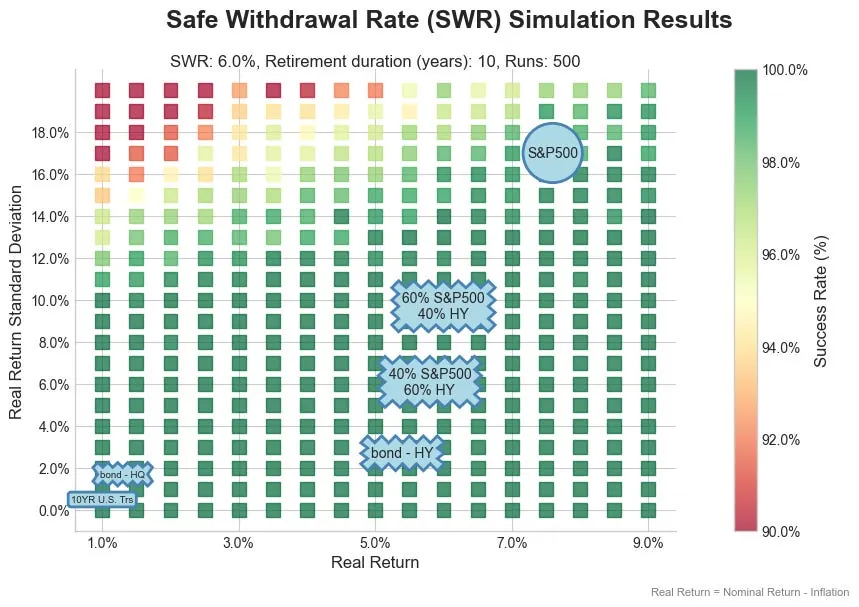
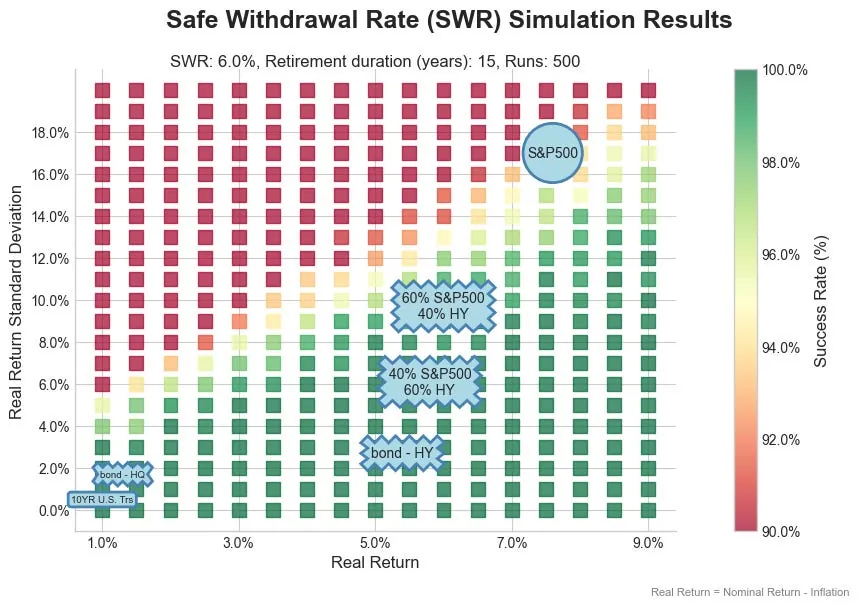
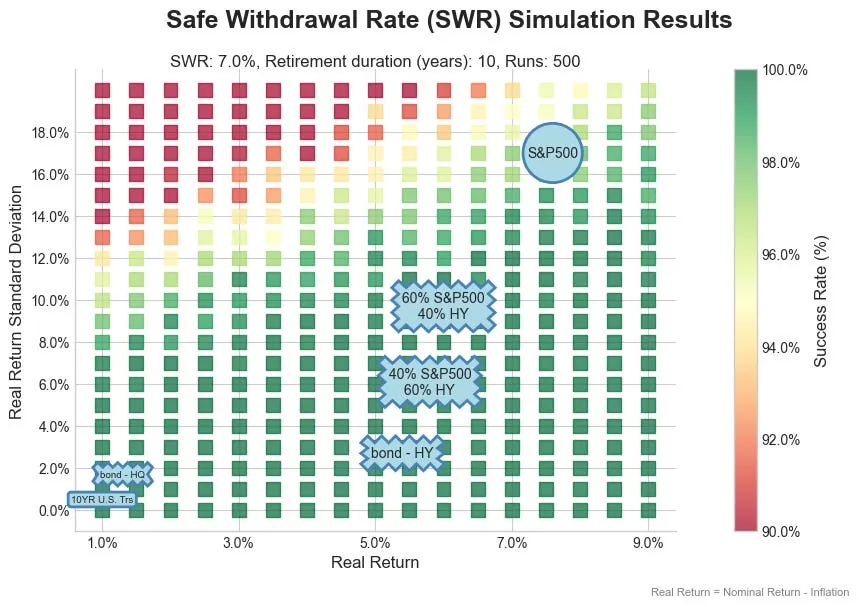
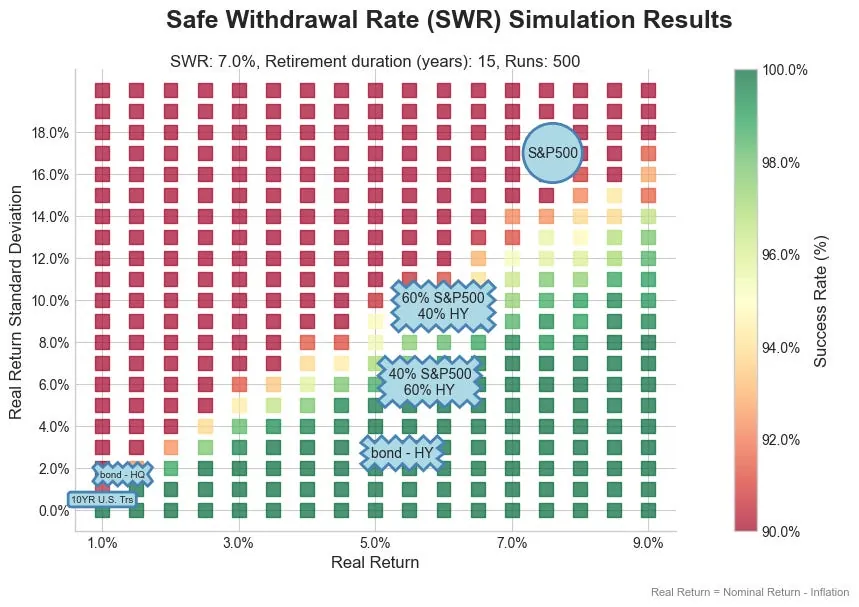
Key Insights from 6.0% and 7.0% SWR Sweeps
Shorter horizons allow retirees to safely extract higher real cash flow. Over a 10-year window, a 7.0% SWR maintains a green survival profile across typical multi-asset return and volatility ranges.
Historical Market Sweeps: 20-Year Horizon at a 4.5% SWR (100% S&P 500 Equity Allocation)
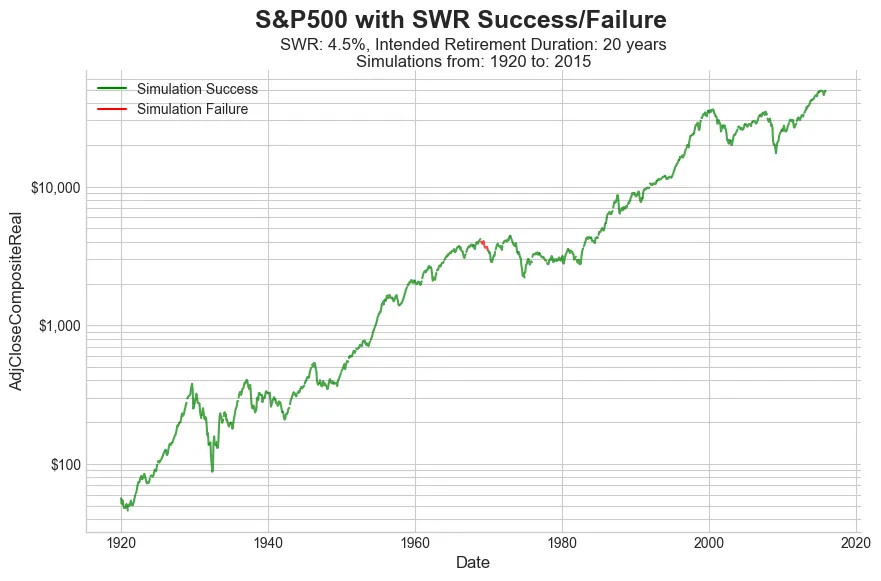
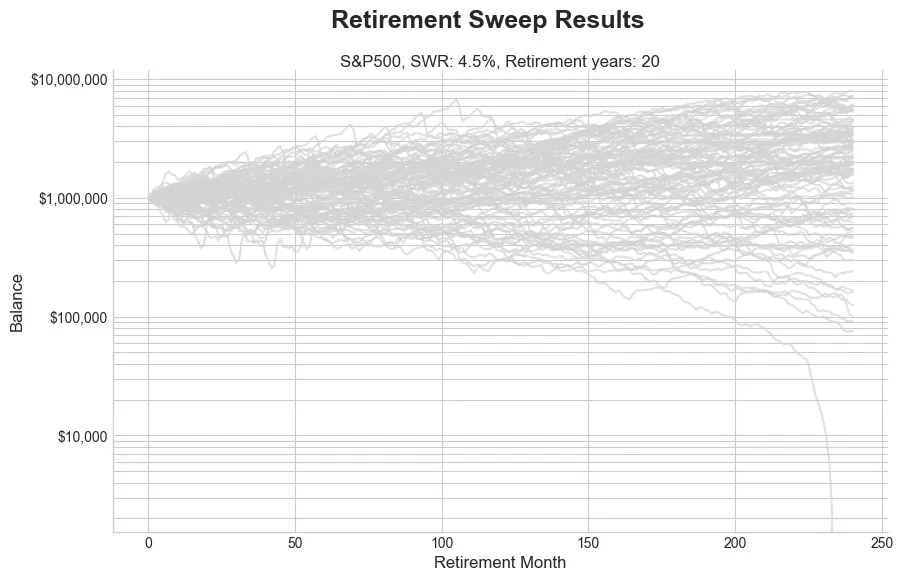
To test these parametric models against real-world market shocks, I ran rolling historical decumulation sweeps for a 100% S&P 500 equity portfolio allocation starting in 1928.
20-Year Historical Results
- 98.5% Survival Rate: Across 936 rolling 20-year monthly cohorts (1928 to 2005), a 4.5% SWR applied to a 100% S&P 500 equity portfolio allocation achieved a 98.5% success rate (922 of 936 cohorts survived).
- Failure Cohorts: Ruin occurred in only 14 monthly cohorts (10 months in 1929 from Feb–Nov, 3 months in 1930 from Apr–Jun, and Dec 1968).
- Annual Jan 1st vs. Monthly Peak Resolution: Retirees who started on January 1st of any year experienced zero 20-year failures because January 1st starting balances benefited from early-year gains before market tops hit. High-density monthly backtesting isolates the exact peak-market start dates (such as late spring/summer 1929) where sequence risk caused depletion in years 19–20.
Historical Market Sweeps: 10-Year Horizon at 7.0% & 8.0% SWRs (100% S&P 500 Equity Allocation)
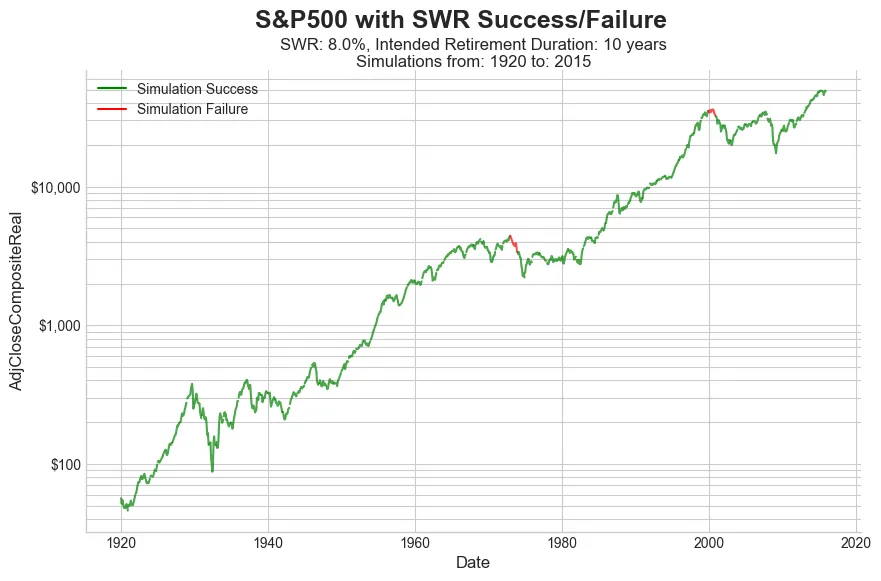
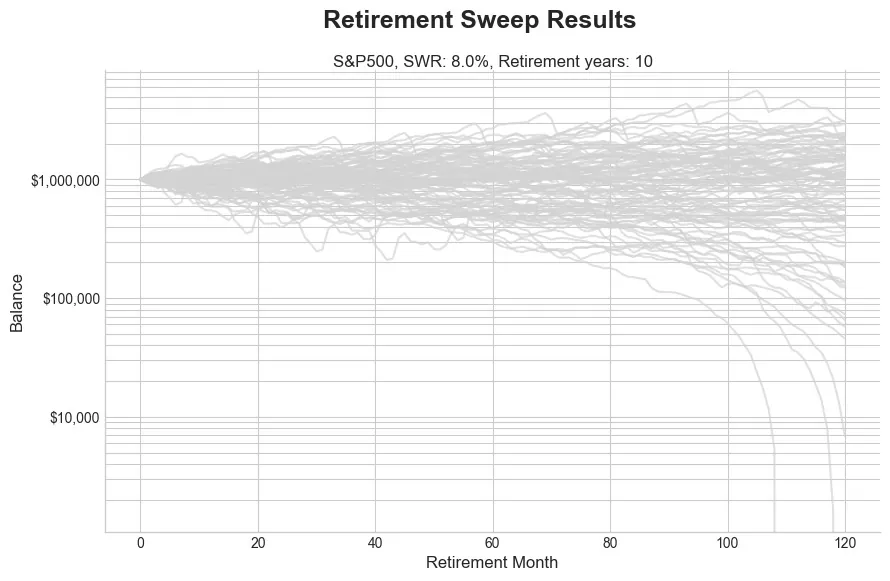
Because a 7.0% SWR achieved a 99.3% historical survival rate over a decade, I stress-tested a higher 8.0% SWR to locate the exact breakpoint where historical market shocks cause portfolio exhaustion within 10 years.
10-Year Historical Results
- 7.0% SWR: Supported a 99.3% survival rate across 1,056 rolling 10-year monthly cohorts from 1928 to 2015 (1,049 of 1,056 cohorts survived, with failures limited to 7 months in 1929–1930).
- 8.0% SWR: Achieved a 96.1% survival rate (1,015 of 1,056 cohorts survived). Historical failures (41 monthly cohorts) clustered around peak valuation crashes followed by severe bear markets (1928–1930, 1937, 1968, 1972–1973, and 2000).
Key Takeaways
- Horizon Dictates Withdrawal Capacity: Retirement length is the primary variable governing safe withdrawal rates. Shorter durations (10–15 years) reduce sequence risk exposure, unlocking 4.5%–7.0%+ withdrawal rates.
- Equity Volatility Is More Tolerable Over Short Spans: Over a 10-to-15-year bridge, a 100% S&P 500 equity portfolio allocation maintained a 99.8% survival rate at 4.5% SWR (15-yr) and a 99.3% survival rate at 7.0% SWR (10-yr).
- Sequence Risk Is Front-Loaded: Sequence of returns risk strikes hardest during the first 5 to 7 years of decumulation. As shown in the multi-panel decumulation trajectory plots, portfolios that survived initial market drawdowns maintained substantial real wealth at horizon end.
- Prioritize Minimal Necessary Risk: Even if historical math shows a 7.0% or 8.0% SWR succeeded over short horizons, taking on more equity risk than required to meet your retirement income goals is unnecessary.