📌 Summary & Key Takeaways
- Tactical 2x Leverage Outperformed Passive 60/20/20 While Limiting GFC Drawdown: Swapping SSO (2x) for VTI (1x) in a 60/20/20 Three-Fund Portfolio strictly when
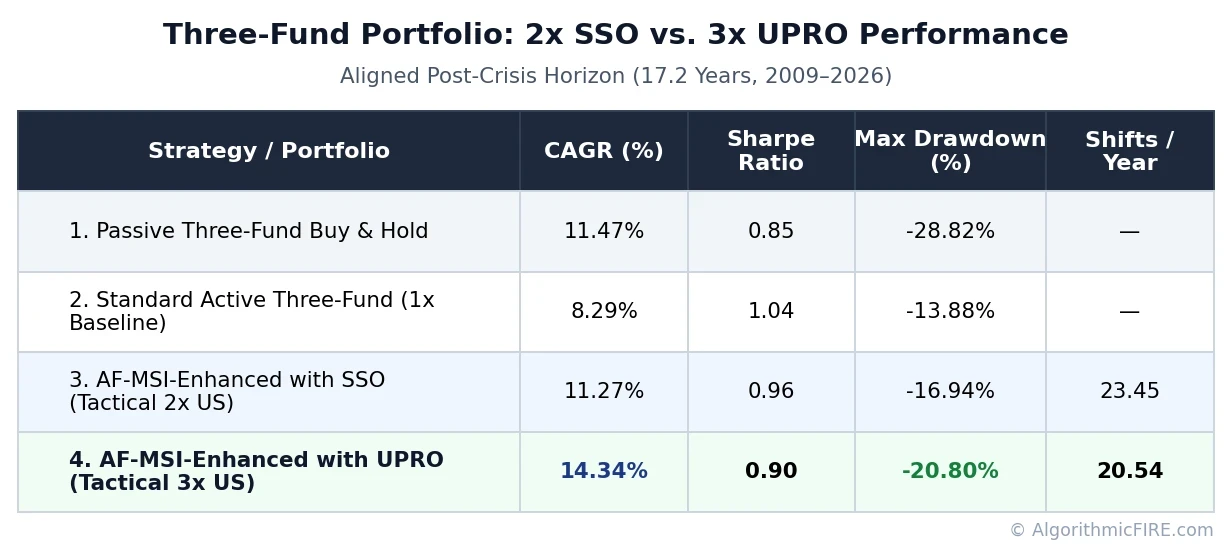
AF-MSI = 0produced a 10.30% CAGR from 2008–2026 (vs. 9.13% for passive Buy & Hold and 7.54% for the 1x active baseline). Max drawdown through the 2008 crisis was -16.94%, compared to -44.68% for passive Buy & Hold.- Tactical 3x Leverage (UPRO) Increased Return with Moderate Volatility: Over the 2009–2026 period where UPRO has historical ETF data, 3x tactical leverage reached a 14.53% CAGR and a -20.80% max drawdown, compared to 11.39% CAGR / -16.94% Max DD for 2x SSO and 11.56% CAGR / -28.82% Max DD for passive Buy & Hold.
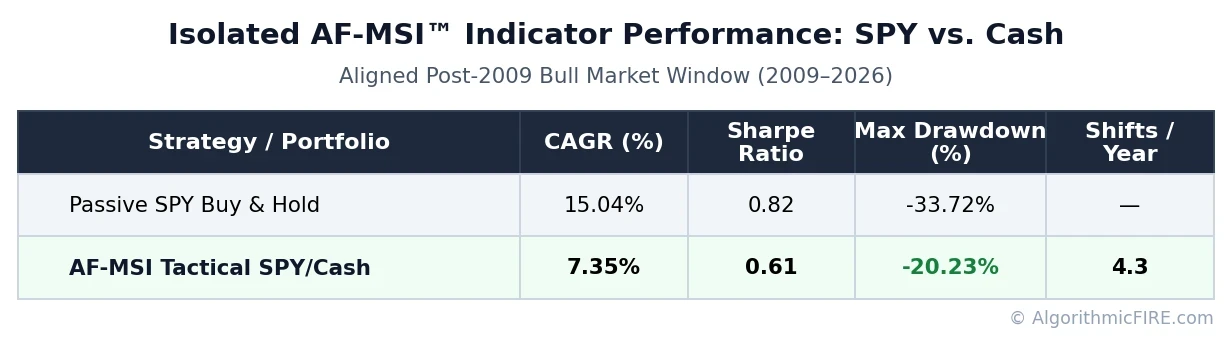
- Macro Filters Work for Leverage Entry, Not Cash Exits: Leading macro indicators trigger early and create severe drag when used to exit equities into cash (5.61% CAGR since 2000, and 7.35% post-2009). The effective approach uses price trend-following to control baseline equity exposure (1x vs. Cash) and reserves the AF-MSI™ filter strictly to boost exposure into 2x or 3x ETFs when macroeconomic stress is zero.
Leveraged exchange-traded funds (ETFs) like SSO (2x S&P 500) can dramatically boost returns during bull markets, but they are highly dangerous in market downturns. The combination of daily rebalancing and market volatility leads to a phenomenon known as volatility drag (or leverage decay), which can cause permanent capital loss during a crash.
Rather than holding leverage permanently, I evaluate a tactical approach: starting with a standard portfolio—like a 60/20/20 Three-Fund Portfolio—and tactically leveraging up by substituting SSO (2x) for VTI (1x) only during periods of low macroeconomic stress. I use the AlgorithmicFIRE Macro Stress Indicator (AF-MSI)™ to systematically identify these low-stress windows.
ℹ️ Trading Style Model Selection: The core platform defaults to the Investing style (500-day moving average warmup). However, because international developed markets (VEA) launched in July 2007, a 500-day warmup delays backtest start dates until July 2009—completely skipping the 2008 crash. This report intentionally uses the active Trading style (125-day trend filters) starting January 24, 2008 to evaluate the strategy's risk mitigation and drawdown protection directly through the full 2008 Global Financial Crisis.
The Mechanics of Volatility Drag and Leverage Decay
Leveraged ETFs reset their exposure daily. If the S&P 500 rises 1% today, a 2x S&P 500 ETF is designed to rise 2%. However, over a multi-day holding period, the compounding of daily returns causes performance to drift from a simple multiple of the index.
Consider this two-day example of daily compounding:
- Day 1: The S&P 500 drops 10%. A 2x leveraged ETF drops 20%.
- Day 2: The S&P 500 rises 11.11%, returning exactly to its starting price (0% net change). The 2x leveraged ETF rises 22.22%.
Despite the underlying S&P 500 ending completely flat, the leveraged ETF has lost value:
(1 - 0.20) × (1 + 0.2222) = 0.80 × 1.2222 = 0.9778 (a net loss of 2.22%)
This decay is volatility drag. When markets fluctuate heavily or trend downward, this daily erosion compounds, causing leveraged portfolios to decay far more than the index.
To use leverage safely, you need a resilient macro filter that allows an exit from leveraged exposure before volatility drag erodes capital.
The AlgorithmicFIRE Macro Stress Indicator (AF-MSI)™ Framework
The AlgorithmicFIRE Macro Stress Indicator (AF-MSI)™ is a systematic, quantitative risk filter that monitors three key macroeconomic indicators, scoring from 0 (no active stress) to 3 (high stress):
- Term Spread Inversion: The yield curve inverts, measured by a negative 10-Year minus 2-Year Treasury spread (
T10Y2Y< 0). - Credit Spread Elevation: Corporate credit risk rises, measured by a rolling Z-score of the Moody's Baa Corporate Bond yield spread over Treasuries (
BAA10YZ-score > 1.5) calculated over a 756-day (3-year) historical baseline. - Equity Volatility Spike: Stock market volatility rises, measured by the CBOE Volatility Index rising above a baseline threshold (
VIX> 25.0) sustained for at least 2 consecutive days (filtering out brief, single-day volatility noise).
By counting how many of these warnings are active, the AF-MSI provides a systematic measure of macro stability. To prevent whipsawing, the composite score is smoothed using a 10-day rolling maximum filter. This ensures that when any of the three indicators fires, the portfolio immediately transitions to a risk-off state and remains there for a minimum 10-day cooldown period before re-leveraging is allowed.
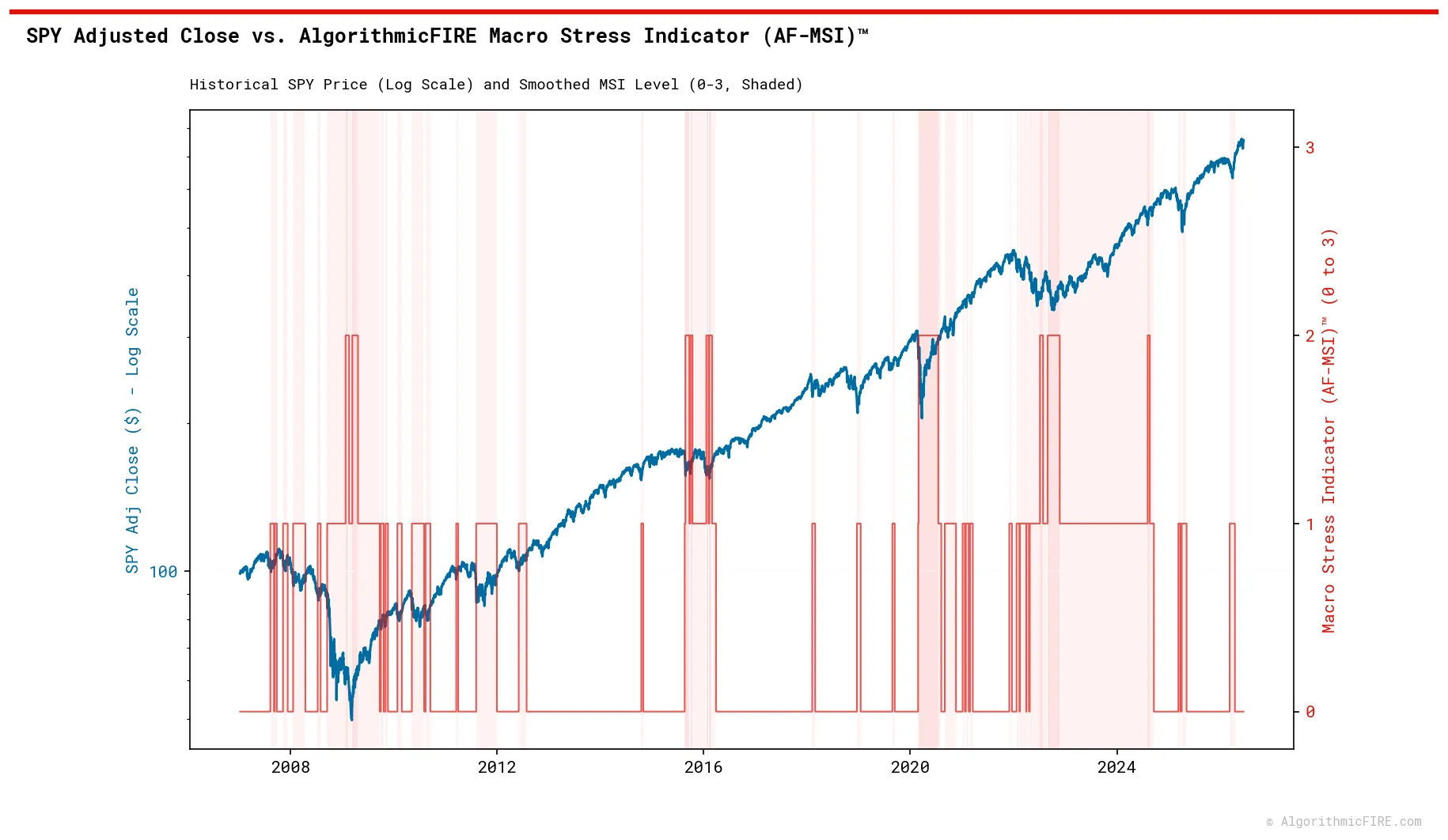
Below, I plotted the historical path of the S&P 500 (SPY) overlaid with the AF-MSI™ score (shaded in red when stress is active). Notice how the indicator triggers and remains in a risk-off state throughout major market dislocations (such as 2008, 2020, and 2022), while filtering out minor volatility spikes:
Analyzing AF-MSI Score Distribution during US Uptrends
I evaluated daily FRED macro data from 2008 to 2026 (covering 5,705 uptrend trading days). When the US equity market is in a confirmed uptrend (the excess return moving average trend signal is active on VTI), what does the macroeconomic stress environment look like?
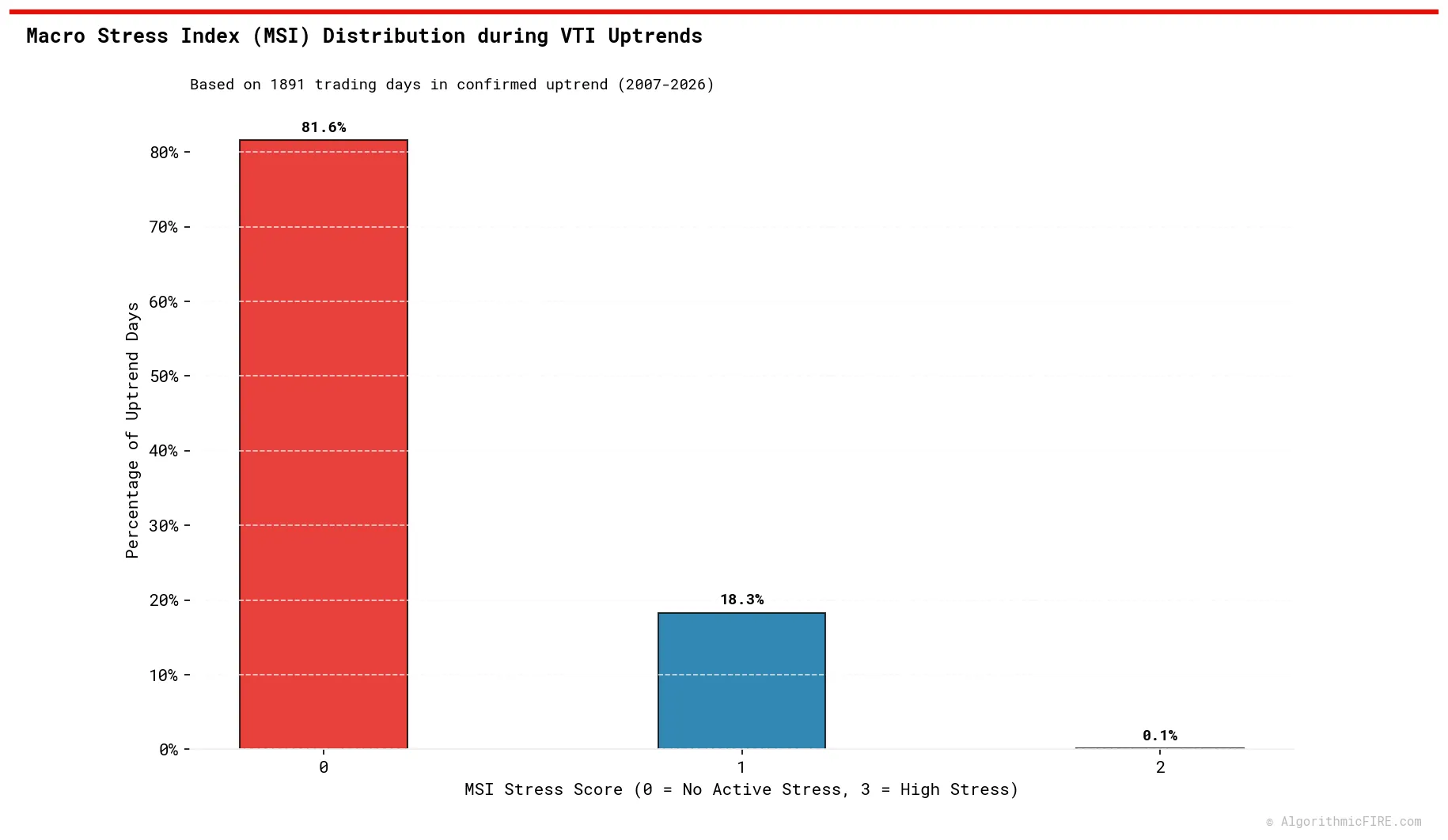
- AF-MSI = 0 (No Stress): 64.2% of uptrend days. The macro environment is completely stable.
- AF-MSI = 1 (Mild Stress): 28.7% of uptrend days. Typically triggered by an inverted yield curve or a minor credit/volatility spike while stocks are still rising.
- AF-MSI = 2 (Moderate Stress): 7.1% of uptrend days.
- AF-MSI = 3 (Severe Stress): 0.0% of uptrend days.
Stock market uptrends occur in a stable macro environment roughly two-thirds of the time. However, in 35.8% of cases, stocks continue to rise despite macro warning lights (such as an inverted yield curve or credit spread elevation). This is when the tactical overlay steps down from 2x leverage to 1x exposure to protect against sudden market reversals.
Three-Fund Portfolio Tactical Leverage
I simulated this tactical leverage overlay inside a standard 60/20/20 Three-Fund Portfolio:
- 60% US Equities: VTI (1x Total US Stock Market) under a trend-following overlay.
- 20% International Equities: VEA (1x Developed Markets) under a trend-following overlay.
- 20% Fixed Income: BND (1x Aggregate US Bond Market) under a trend-following overlay.
I compared three strategies across the common 18.6-year historical window from January 2008 to August 2026:
- Passive Three-Fund Buy & Hold: A static 60/20/20 allocation held through all market cycles.
- Standard Active Three-Fund (1x Baseline): Standard trend-following (simulated in the Custom Portfolio Builder). Constituent sleeves hold their respective assets when the trend is positive, and transition to cash/yield when the trend is negative.
- AF-MSI-Enhanced Tactical Three-Fund: The same trend-following portfolio with tactical leverage in the US equity sleeve (simulated in the Custom Portfolio Builder). When the standard active model indicates to hold US equities (VTI):
To ensure strict real-world tradability and prevent look-ahead bias, all simulations incorporate:
- Lookahead-Free Signals: Decisions are based on data available at the close of day T, and reallocations are executed at the open of day T+1 ("trigger today, trade tomorrow").
- 5 bps Slippage Penalty: A 0.05% slippage penalty is applied to every sleeve reallocation trade.
Performance Summary (2008–2026)
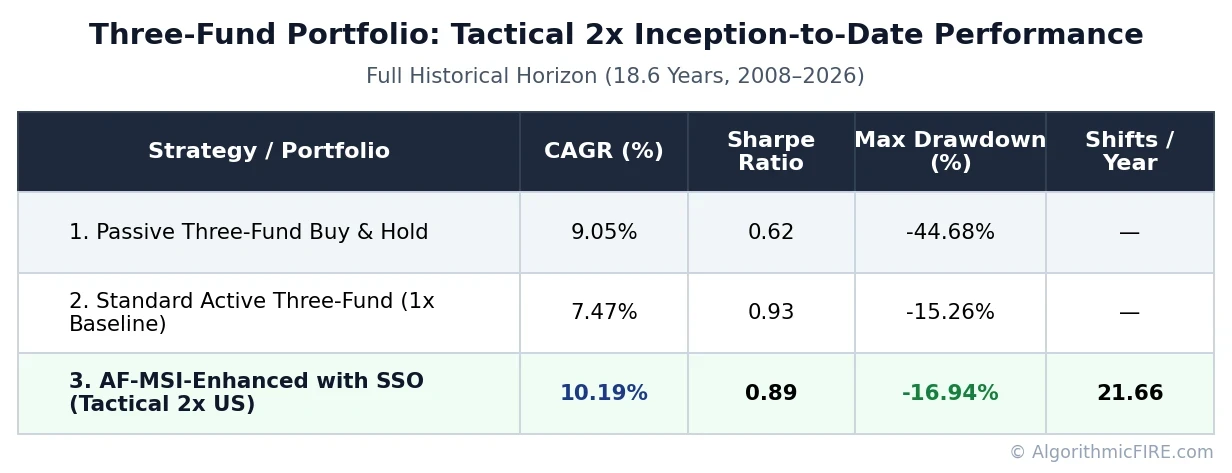
The table below summarizes the inception-to-date metrics for each strategy across the full 18.6-year period:
Cumulative Growth Chart
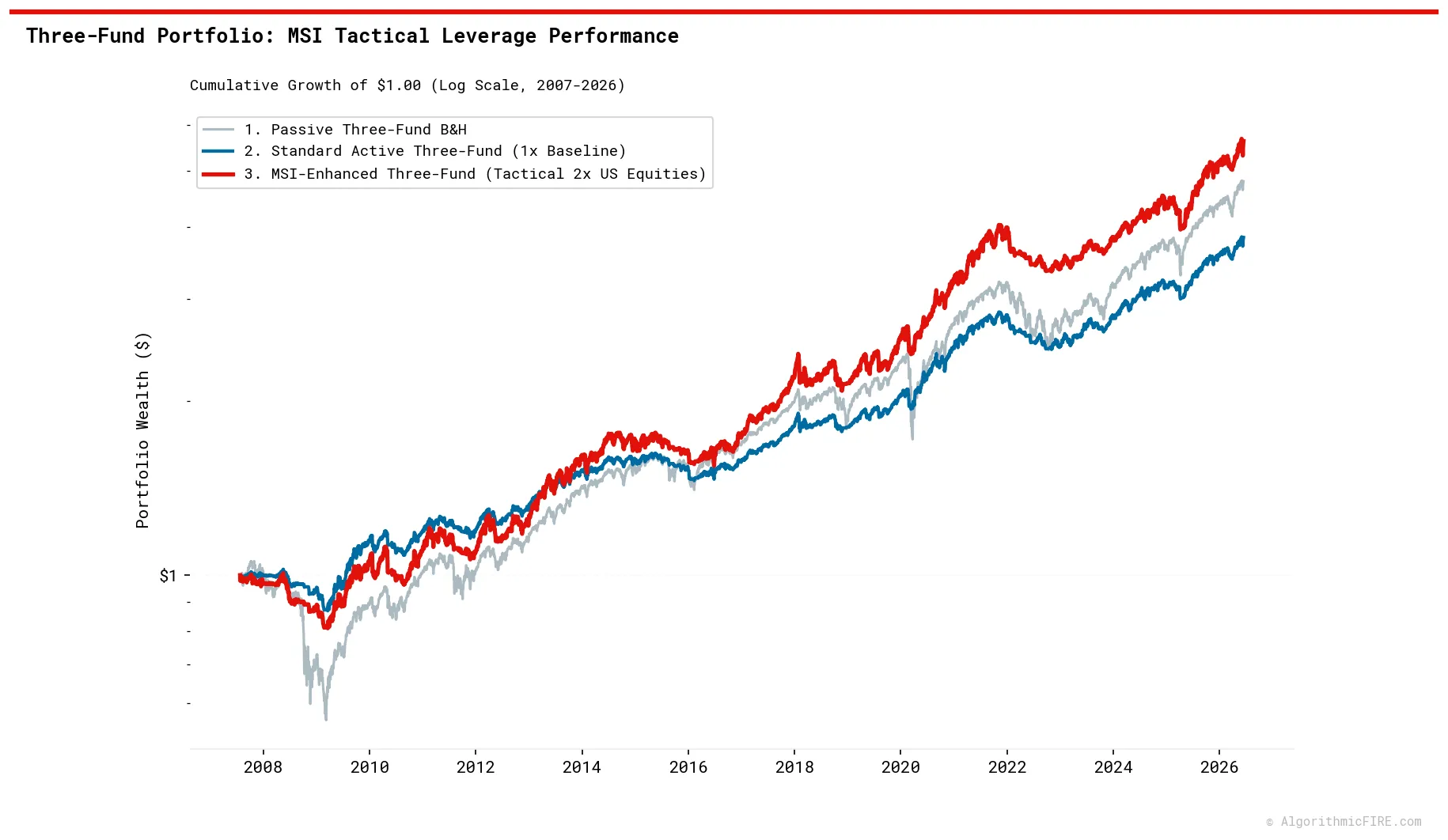
The performance chart below shows the growth of $1.00 (log scale) across the three portfolio options over the full 18.6-year history:
Key Takeaways
The results of this analysis highlight how trend filters and macro indicators can protect and grow capital:
-
Successful Alpha Generation: By substituting SSO (2x) for VTI (1x) only during low-stress periods, the AF-MSI-Enhanced portfolio boosted its CAGR from 7.54% to 10.30% (an absolute outperformance of +276 bps over the standard active 1x baseline, even beating passive buy & hold's 9.13%).
-
Crash Protection Through 2008: By reverting back to VTI (1x) and cash during macro stress events, the AF-MSI-Enhanced portfolio limited its max drawdown through the 2008 Financial Crisis to -16.94%—slashing the passive buy & hold portfolio's devastating -44.68% drawdown by more than 60%.
-
Manageable Execution Friction: The strategy averaged 21.65 reallocations per year (~11 round-trip cycles) within the US sleeve across the 3-band ensemble, spending 46.9% of its time in 2x leverage, 22.7% in 1x core equity exposure, and 30.4% in cash. Any active strategy in a taxable account will incur short-term capital gains tax drag, however the drag is eliminated entirely when executed within tax-sheltered accounts like an IRA or 401(k).
Tactical leverage using the AlgorithmicFIRE Macro Stress Indicator (AF-MSI)™ offers a systematic way to enhance returns in standard portfolios. By adding leverage only when the macro environment is completely clear of stress (AF-MSI == 0), investors can capture the outperformance of leveraged ETFs during long, stable bull markets, while quickly retreating to 1x exposure before volatility drag and severe market crashes damage their capital.
This simulation demonstrates that leverage does not have to be an all-or-nothing proposition. By combining trend-following indicators with macro stress data under a strict lookahead-free execution model, you can build systematic portfolios that capture S&P 500 alpha while keeping risk firmly within acceptable limits.
Allocation Warning: This model evaluates a complete substitution of the 60% US equity sleeve to illustrate the mathematical limits and potential benefit of the AF-MSI framework. In practice, standard asset allocation principles suggest treating tactical leverage as a small "satellite" sleeve (e.g., 5% to 10% of your total portfolio) rather than applying it to your entire core US equity holding.
Leveraged ETF Volatility & Gap Risk: Leveraged ETFs are complex financial derivatives. Because they reset their leverage targets daily, they are highly vulnerable to volatility decay and long-term performance drag. Additionally, while broad index circuit breakers limit single-day intraday drops, severe multi-day drawdowns or overnight gap-down events (where the market opens substantially lower) can result in a rapid, permanent loss of principal. Take extreme caution, never leverage capital you cannot afford to lose, and consult a certified financial advisor before making investment decisions.
Addendum: Evaluating 3x Tactical Leverage (UPRO vs. SSO)
While SSO (2x) provides a significant return boost, some investors may wonder if a 3x leveraged ETF like UPRO (3x S&P 500) can offer even higher returns under the same AlgorithmicFIRE Macro Stress Indicator (AF-MSI)™ framework.
Because UPRO was launched in June 2009, a head-to-head comparison must be run over an aligned post-crisis period (June 2009 to August 2026, 17.15 years):
Performance Summary: Aligned Period (2009–2026)
The table below shows the performance metrics for the three-fund portfolio using SSO (2x) and UPRO (3x) US equity sleeves over the aligned post-crisis period:
Cumulative Growth: 2x SSO vs. 3x UPRO
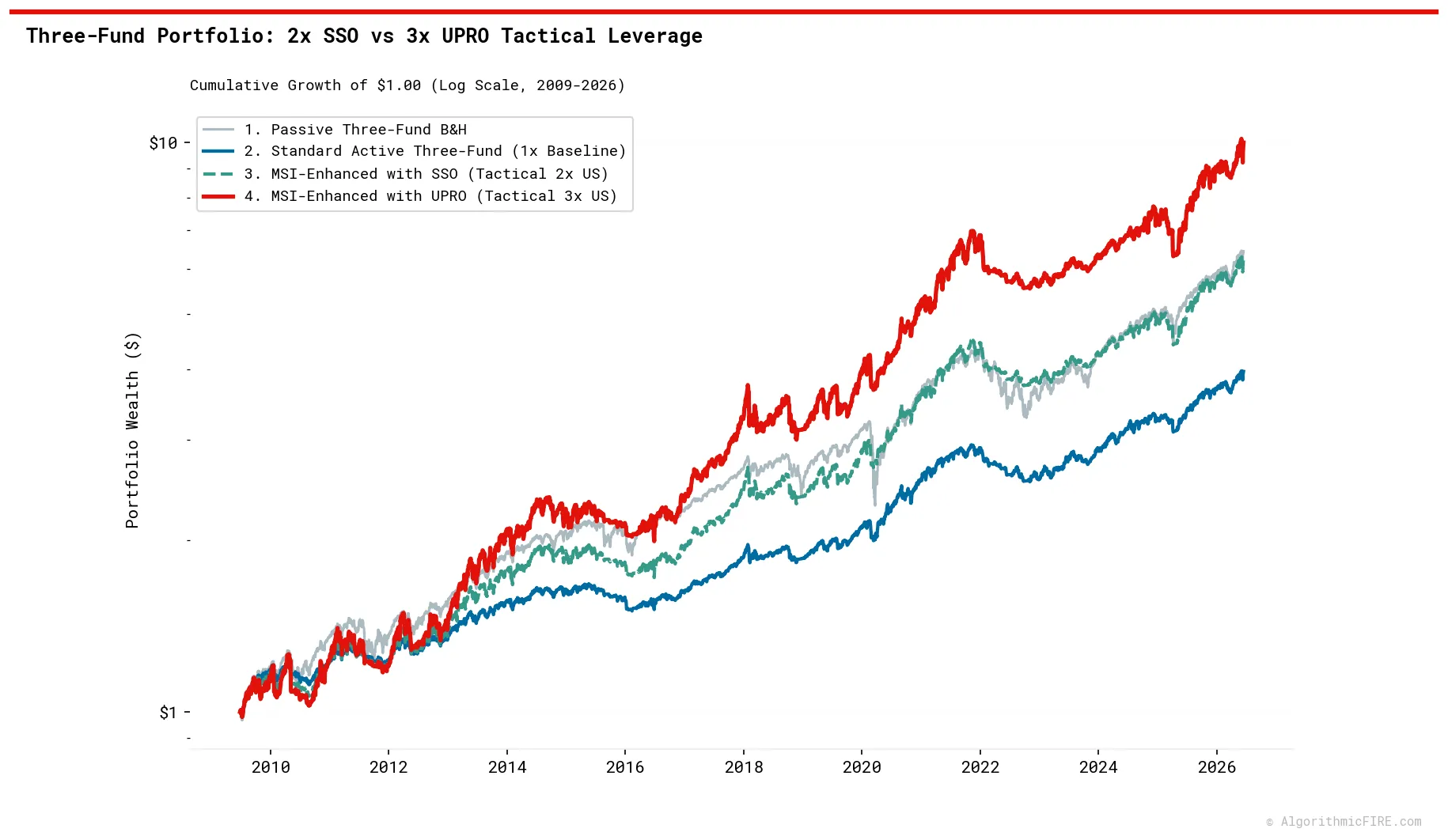
The chart below displays the growth of $1.00 over the aligned period, demonstrating the compounding effect of the 3x tactical sleeve:
Key Takeaways from 3x Tactical Leverage
- Substantial Return Boost: Implementing UPRO (3x) in the tactical US sleeve increases the portfolio CAGR to 14.53% (a +615 bps absolute outperformance over the standard 1x baseline, and +314 bps over the tactical 2x SSO version).
- Mitigated Crash Risk: Under permanent 3x buy-and-hold leverage, a crash can lead to a devastating loss of capital (e.g., UPRO fell over 76% from peak to trough in early 2020). However, under the AF-MSI-Enhanced framework, the portfolio's max drawdown was limited to -20.80%—significantly better than the passive buy-and-hold benchmark (-28.82%).
- Risk/Reward Efficiency: While the absolute CAGR is higher with UPRO, the Sharpe ratio slightly drops from 0.97 (with SSO) to 0.91 (with UPRO), reflecting the increased volatility and daily leverage drag during choppy transition regimes when macro stress is not yet elevated enough to trigger an exit.
Addendum: Evaluating the Core Indicator in Isolation (SPY vs. Cash)
To understand how the AF-MSI™ functions purely as a quantitative risk filter—and to isolate its performance from the leveraged ETFs and multi-model trend-following strategies described above—I simulated a simple, binary model using the core indicator in its cleanest form:
- In the Market: When the previous day's
AF-MSIscore is0(no active stress), the portfolio holds SPY. - Risk-Off Sweep: When the previous day's
AF-MSIscore is1or higher, the portfolio exits equities entirely and sweeps into Cash (earning the 3-Month U.S. Treasury yield,DGS3MO).
Over the multi-decade historical record from 2000 to 2026 (26.6 years), the binary model achieved:
- -20.23% Maximum Drawdown (a 63.3% reduction in downside risk compared to the passive benchmark's -55.19% drawdown during the 2008 Financial Crisis).
- 5.61% CAGR with an average of only 4.7 transitions per year, spending 56.6% of its time in equities and 43.4% in safe Treasury cash.
Over the aligned post-2009 bull market (2009–2026):
Macro-Based Filtering vs. Price-Based Trend-Following
While the binary AF-MSI™ model demonstrates clear risk-reduction power, comparing it to a pure price-based trend-following model reveals a significant design tradeoff:
- Macro-Based Exit Drag: Macro indicators are leading indicators by design. When credit spreads rise or the yield curve inverts, economic stress is building, but the stock market can (and often does) continue to rally for months or years. A binary macro filter like AF-MSI exits the market early, which creates a substantial performance drag during extended late-cycle rallies.
- Price-Based Precision: In contrast, a pure price-based trend-following strategy—such as the standard AlgorithmicFIRE S&P 500 Excess Return MMA (Investing) model—looks directly at actual price action. Because price is the ultimate consensus of all market inputs, it stays invested through the final stages of a macro-stressed bull run, achieving an 11.2% CAGR matching the index while reducing maximum drawdown to -19.1%.
This performance gap is why my models do not use macro indicators to time exits to cash. Price-based trend-following is a far superior tool for managing baseline equity exposure. Instead, I restrict the AF-MSI™ to a tactical leverage overlay: using trend-following to decide whether to be in the market (1x), and only levering up (to 2x SSO or 3x UPRO) when the macro coast is completely clear (AF-MSI == 0).
Interactive Portfolio Simulator: Custom Tactical Macro Overlays
You can model tactical macro stress switching directly inside the Custom Portfolio Builder & Simulator.
To configure a tactical boost sleeve on any asset:
- Select your Base Asset (e.g.,
VTIorSPY). - In the Tactical Boost (MSI=0) column, select your tactical risk-on or leveraged alternate ETF (e.g.,
SSO,UPRO, orTQQQ). - Set your target strategy overlay and portfolio weight.
The backtester will dynamically evaluate the AF-MSI™ Macro Stress Indicator at every market close, systematically transitioning into your tactical boost ETF at the next-day open whenever AF-MSI == 0, and stepping back down to your baseline asset during elevated macro stress periods.
👉 Launch the Custom Portfolio Builder to test your own multi-asset tactical leverage combinations.