📌 Summary & Key Takeaways
- Traditional Dominates at Medicare Age (65+): For households retiring at age 65 with starting incomes of $50k–$300k (whose wages triple over their careers) and 5%–20% savings rates, staying 100% Traditional delivered the highest lifetime spending across all 120 cohorts. Committing purely to Roth forces upfront tax payments at peak career brackets (22%–32%+), resulting in a 10.4% to 24.9% annual spending shortfall in retirement—costing a representative $150k earner $11,307/year (more than $339,000 over a 30-year retirement).
- The Marginal vs. Effective Spread Drives the Math: Saving pre-tax deducts income at your highest career marginal bracket (22%–32%+), but retirement withdrawals fill brackets from the bottom up. Thanks to expanded standard deductions ($32,200 for married couples, $35,500+ for seniors), Traditional distributions encounter an effective federal tax rate of ≤ 10% in 84.7% of solvent scenarios and ≤ 15% in 91.9% of cases.
- Early Retirees (Pre-65) Win with a Hybrid Allocation: For early retirees who must buy private health insurance on the ACA marketplace before Medicare begins at age 65, healthcare subsidies flip the math. An optimal hybrid mix (such as $1,035,000 Trad / $193,000 Roth for an age-55 retiree starting at $150k) delivers the highest lifetime spend at $67,299/year—beating 100% Traditional by +9.7% and 100% Roth by +47.3%.
- The "Just Enough for FPL" Subsidy Trap: Saving only enough Traditional to reach the 138%–200% ACA poverty line corridor during the pre-Medicare gap ($225k Trad / $824k Roth) leaves money on the table ($58,656/year). Depleting Traditional by age 65 forces 100% Roth withdrawals for the remainder of life, completely throwing away over $1,060,000 in tax-free senior standard deductions across a 30-year retirement.
- Social Security Raises the Tax Floor but Keeps Traditional Ahead: Claiming Social Security at age 67 fills lower tax brackets, dropping the proportion of scenarios with effective tax rates ≤ 10% from 84.7% to 39.3%. Even so, Traditional retains a +3.9% to +7.8% spending advantage across modeled baseline scenarios because peak working deductions still beat retirement effective tax rates (7.0% to 20.8%).
In my previous posts, I established two foundational concepts:
- The Tax Rate Reality: The conventional advice comparing your current tax bracket to your expected bracket in retirement is incomplete. What matters is your current marginal rate vs. your future effective rate. Because of the standard deduction and progressive brackets, the effective tax rate on withdrawals in retirement is almost always lower than your marginal deduction rate during your career.
- The ACA Subsidy Opportunity: For early retirees, having Traditional IRA funds is an essential tax engineering tool. By generating controlled amounts of taxable income, you can qualify for ACA Premium Tax Credits that substantially reduce or eliminate health insurance premiums before Medicare begins at age 65.
Both of those analyses looked at narrower, standalone questions. In this post, I put the entire lifecycle together. I modeled the complete wealth trajectory—pure accumulation in each vehicle during your working career, followed by dynamic decumulation and multi-year conversion optimization through death—across a comprehensive grid of incomes, savings rates, and retirement ages.
Accumulation vs. Decumulation Modeling: During accumulation, I modeled pure single-vehicle savings paths as well as mid-career switching schedules (testing shifts from Traditional to Roth at 3-year intervals). In decumulation, both portfolios run through the same dynamic withdrawal engine—optimizing standard deduction harvesting, ACA healthcare subsidies, dynamic multi-year Roth conversions, and mandatory RMDs through age 95.
1. The Core Conflict & The Flawed Rule of Thumb
The standard rule of thumb taught across personal finance media is simple: expect a higher tax bracket in retirement? Use a Roth. Expect a lower bracket? Use Traditional.
On the surface, avoiding a 22% tax today while paying only 12% on withdrawals in retirement seems like a clear win for Traditional. And it often is. But more forces are at play than a single static bracket comparison suggests.
Factors that work in Roth's favor:
- ACA Subsidies Pre-65: Higher Traditional withdrawals (MAGI) can phase out thousands of dollars in health insurance subsidies before age 65, acting as a steep shadow tax.
- Medicare IRMAA Surcharges: High MAGI after age 65 can trigger Medicare Part B and Part D premium surcharges that act as steep, cliff-like penalties.
- No Lifetime RMDs: Unlike Traditional IRAs, Roth IRAs do not have Required Minimum Distributions (RMDs) during the owner's lifetime, allowing tax-free compounding indefinitely.
- Estate Planning: Heirs inherit Roth IRAs tax-free. Traditional IRA heirs must pay ordinary income taxes on inherited distributions, often during their own peak earning years due to the 10-year SECURE Act depletion rule.
Factors that work in Traditional's favor:
- Accumulation-Phase Deductions: Every dollar saved pre-tax directly reduces taxable income today at your highest marginal rate (22%–32%+).
- Depletion-Phase Deductions: In retirement, the standard deduction ($32,200 for couples, expanding to $35,500+ for seniors) and progressive tax brackets mean that the effective withdrawal rate is almost always far lower than the marginal rate saved during accumulation.
- Strategic Gap-Year Conversions: Early retirees experience low-income gap years before Social Security and RMDs begin. Traditional balances enable low-bracket Roth conversions at minimal tax cost during these windows.
The Simulation Framework
To evaluate these competing forces simultaneously, I simulated the entire lifecycle from your first dollar saved to your last dollar spent across 120 distinct household scenarios:
- Initial Household Incomes: $50,000, $75,000, $100,000, $150,000, $225,000, and $300,000 (married filing jointly, starting baseline at age 35).
- Retirement Ages: 50, 55, 60, 65, and 70 (modeled through age 95).
- Savings Rates: 5%, 10%, 15%, and 20% of gross income.
- Economic Assumptions:
- Career Wage Growth: An average real wage increase of 3.7% per year above inflation until retirement. Over a working career (ages 35 to 65), real earnings compound by 1.7x to nearly 3x (e.g. (1 + 0.037)²⁰ ≈ 2.07 or 2.1x by age 55 to ~$310k, and (1 + 0.037)³⁰ ≈ 2.98 or ~3.0x by age 65 to ~$447k for a $150,000 starting baseline). This escalation pushes late-career earnings into peak marginal tax brackets (24%–32%+).
- A constant 5.0% real return (0 volatility) across both working and retirement years to cleanly isolate pure tax and vehicle mechanics from sequence of returns risk.
- Equal Economic Savings Effort: A $1.00 gross savings allocation becomes $1.00 deposited into Traditional pre-tax, or (1 - tax rate) into Roth after upfront income taxes. This guarantees both households maintain identical take-home pay and living standards during their careers.
- Statutory Limits & Brokerage Spillover: Annual contributions are capped at IRS limits ($46,000 for a married couple across 401(k) plans). Any savings exceeding statutory caps is taxed and invested into a standard taxable brokerage account.
- RMDs Enforced: Required Minimum Distributions are enforced on Traditional balances beginning at age 75.
- Primary Model Baseline: Social Security is set to $0 in the primary model to isolate vehicle mechanics, then fully integrated in Section 6.
2. Accumulation Phase: Pre-Tax Leverage & The Starting Line
How does the tax difference play out while you are working?
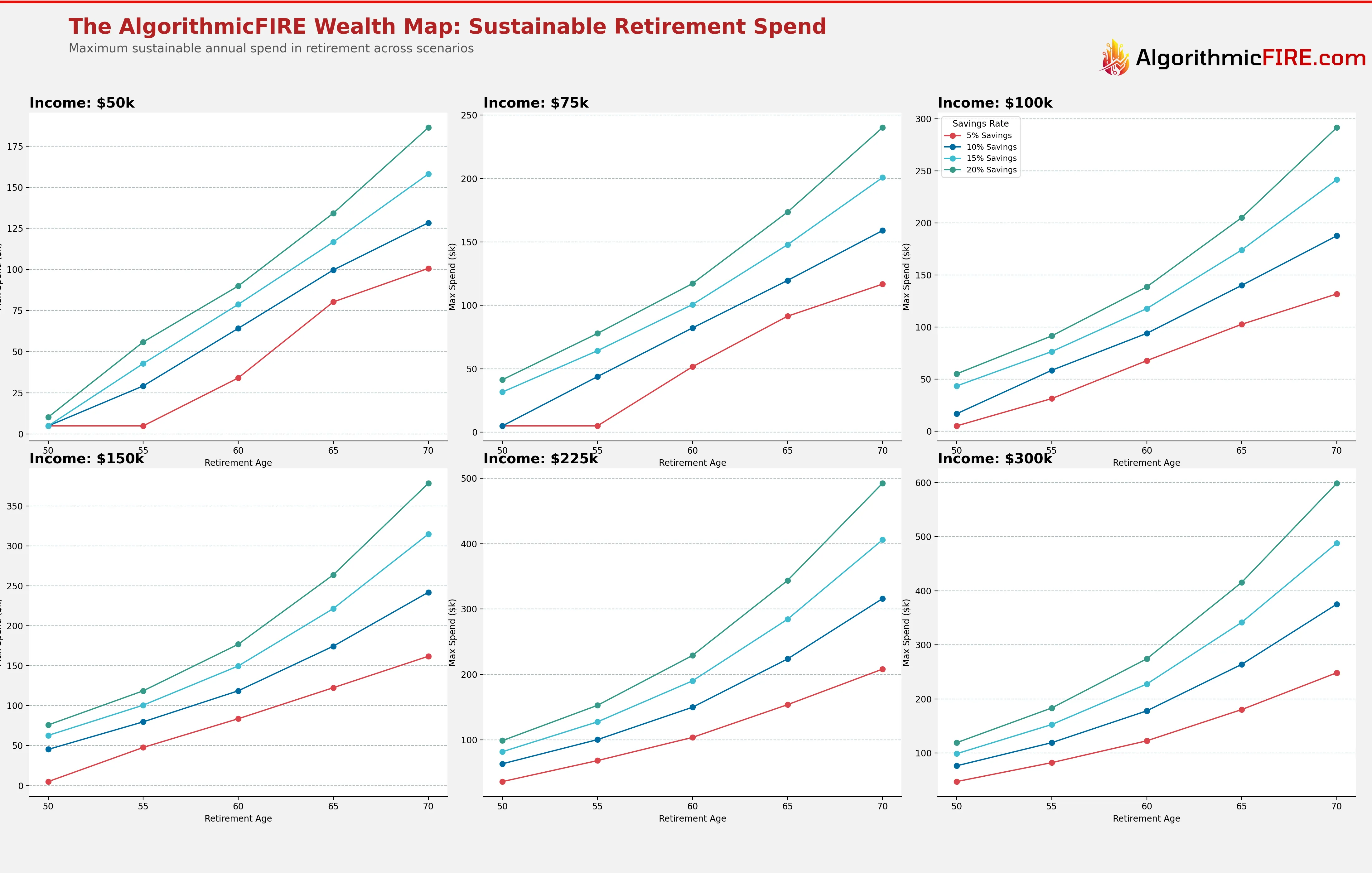
The side-by-side chart below compares the annual deposited savings for a household starting at $150,000 income at age 35 (saving 15% across ages 35 to 59, with earnings reaching ~$363,000 at age 59):
Key observations from the working career:
- The Pre-Tax Compounding Advantage: Because Traditional contributions are made with pre-tax dollars, the full 15% gross allocation enters the 401(k) (blue bars). In contrast, Roth contributions require paying upfront income taxes (22%–24%), resulting in smaller annual deposits (red bars) for the exact same take-home pay sacrifice.
- Taxable Brokerage Spillover Begins at Age 55: Around age 55, as career income crosses $310,000 (more than doubling from the $150,000 starting base), the 15% savings target exceeds the statutory $46,000/year 401(k) limit. The simulation automatically routes the excess after-tax dollars into a standard taxable brokerage account (gray bars), maintaining the household's full savings discipline.
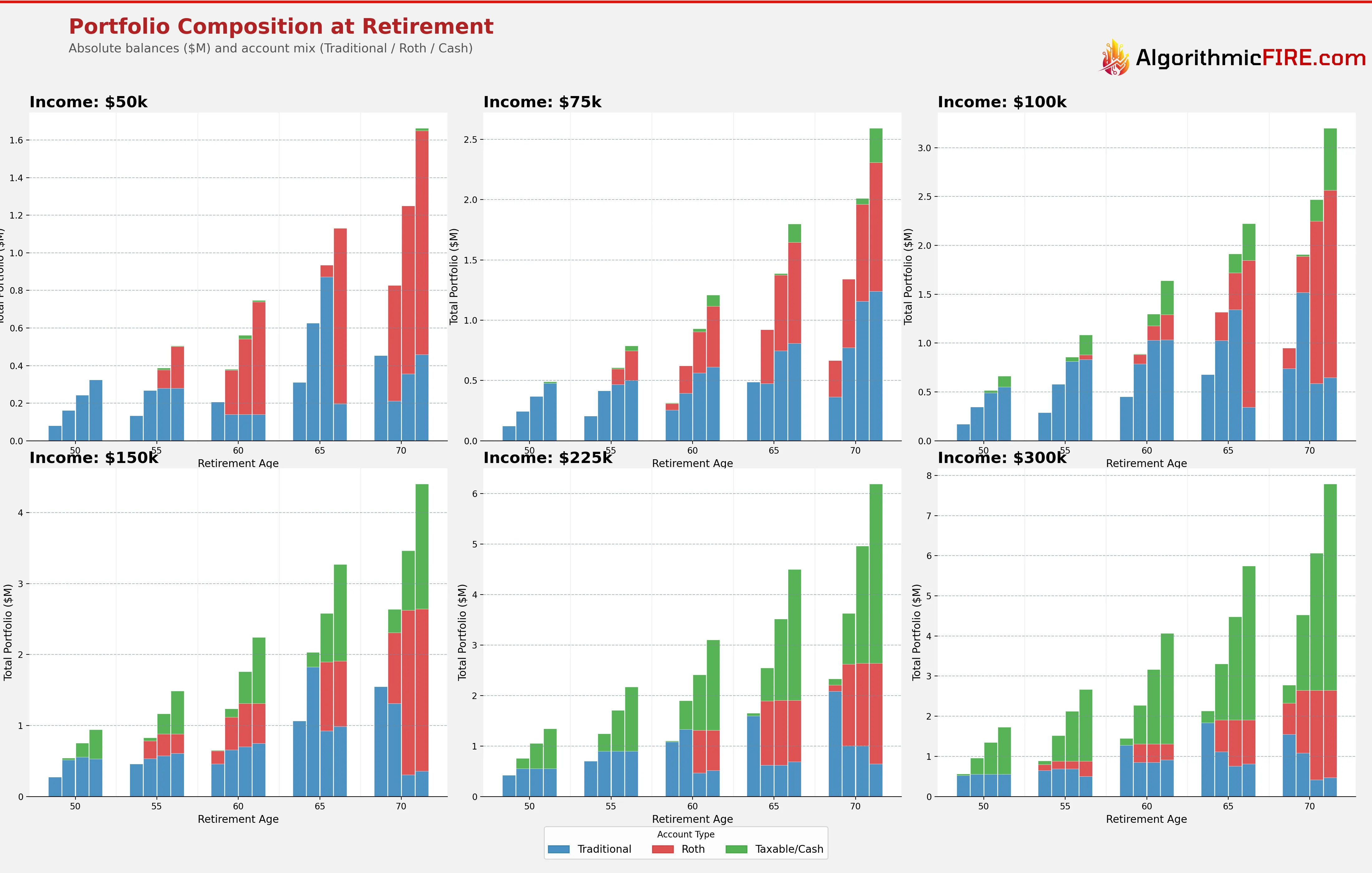
By the time the household reaches retirement, this savings effort produces vastly different nominal asset pools (illustrated below for an Age 60 retirement with a 15% savings rate across all six starting income levels):
- Larger Nominal Pre-Tax Pool: Traditional contributions enter accounts without tax haircut, compounding significantly more nominal dollars. At retirement, this larger pre-tax pool provides the flexibility to harvest low-bracket withdrawals and strategic conversions.
- Greater Taxable Spillover: Traditional savers accumulate more taxable brokerage spillover (gray bars). Because pre-tax 401(k) deductions lower current annual income tax bills, Traditional savers retain more net cash flow to invest in taxable accounts once 401(k) caps are reached.
3. The Engine: Marginal vs. Effective Tax Arbitrage
Why does a Traditional strategy deliver higher sustainable spending across such a wide range of scenarios? The answer lies in the massive spread between your marginal tax rate during your career and your realized effective tax rate in retirement.
During your working years, every dollar saved pre-tax deducts income at your highest marginal tax bracket (22%, 24%, or 32%+). In retirement, however, Traditional withdrawals do not come out at your career marginal bracket; they fill your progressive tax brackets from the bottom up—starting with the standard deduction ($32,200 for married couples, expanding to $35,500+ for seniors) at a literal 0% effective tax rate.
The 6-panel chart below maps the full lifecycle tax trajectory from Age 35 to Age 95 for an Age 60 retirement across all six starting income levels. The accumulation phase (Ages 35–60, red shaded background) plots the worker's actual marginal tax rate deducted on contributions as career earnings grow. The decumulation phase (Ages 60–95, blue shaded background) plots the actual realized annual effective federal tax rate paid on Traditional distributions across each savings rate (5%, 10%, 15%, and 20%):
Key takeaways from the lifecycle tax trajectory:
- Sub-10% Effective Tax in Retirement (84.7% of Scenarios): Across 84.7% of solvent retirement scenarios, the realized effective federal tax rate on Traditional withdrawals is under 10%—and under 5% for early-to-moderate retirees.
- The Full Lifecycle Arbitrage Cliff: In every single income panel, the transition at retirement (Age 60 vertical divider) reveals an immediate drop in tax rates. A household starting at $150,000 at age 35 saves taxes at a 22.0%–24.0% marginal rate during accumulation (as income grows to ~$372,000), but pays only 0.0% to 8.2% in effective taxes in retirement across all savings rates.
- Why the Retirement Tax Lines Are Choppy (Strategic Conversion Waves): The effective retirement tax curves oscillate between 0% and 8%–18% from year to year. This sawtooth pattern is the signature of multi-year dynamic tax optimization:
- Conversion Surge Years: In specific gap years, the optimizer executes strategic Roth conversions into lower progressive brackets (such as the 10% and 12% brackets) to build tax-free reserves and preempt future forced RMD friction. In these conversion years, taxable income temporarily rises, pushing that year's effective tax rate up to 8%–18%.
- Accumulated Cash Enables 0% Tax Gap Years: In the higher income/savings paths ($225k–$300k earners saving 15%–20%), the effective tax rate sits at literal 0% for the first 2 to 8 years of retirement. Because their career savings spilled over 401(k) limits into taxable brokerage accounts ($645k to $1.38M in accumulated cash), the retiree lives entirely off after-tax cash principal. With zero Traditional withdrawals, qualified dividends and capital gains remain within the 0% federal bracket, creating multi-year spans of $0 federal tax.
4. Decumulation Outcomes: Sustainable Spending Across 120 Cohorts
When we run the dynamic retirement optimizer across all 120 scenarios to solve for maximum constant annual spend through age 95, how do the two vehicles compare?
The chart below compares the sustainable retirement spending ceiling for 100% Traditional (solid lines) versus 100% Roth (dashed lines) across starting incomes, savings rates, and retirement ages:
And the corresponding percentage spending shortfall resulting from committing purely to Roth:
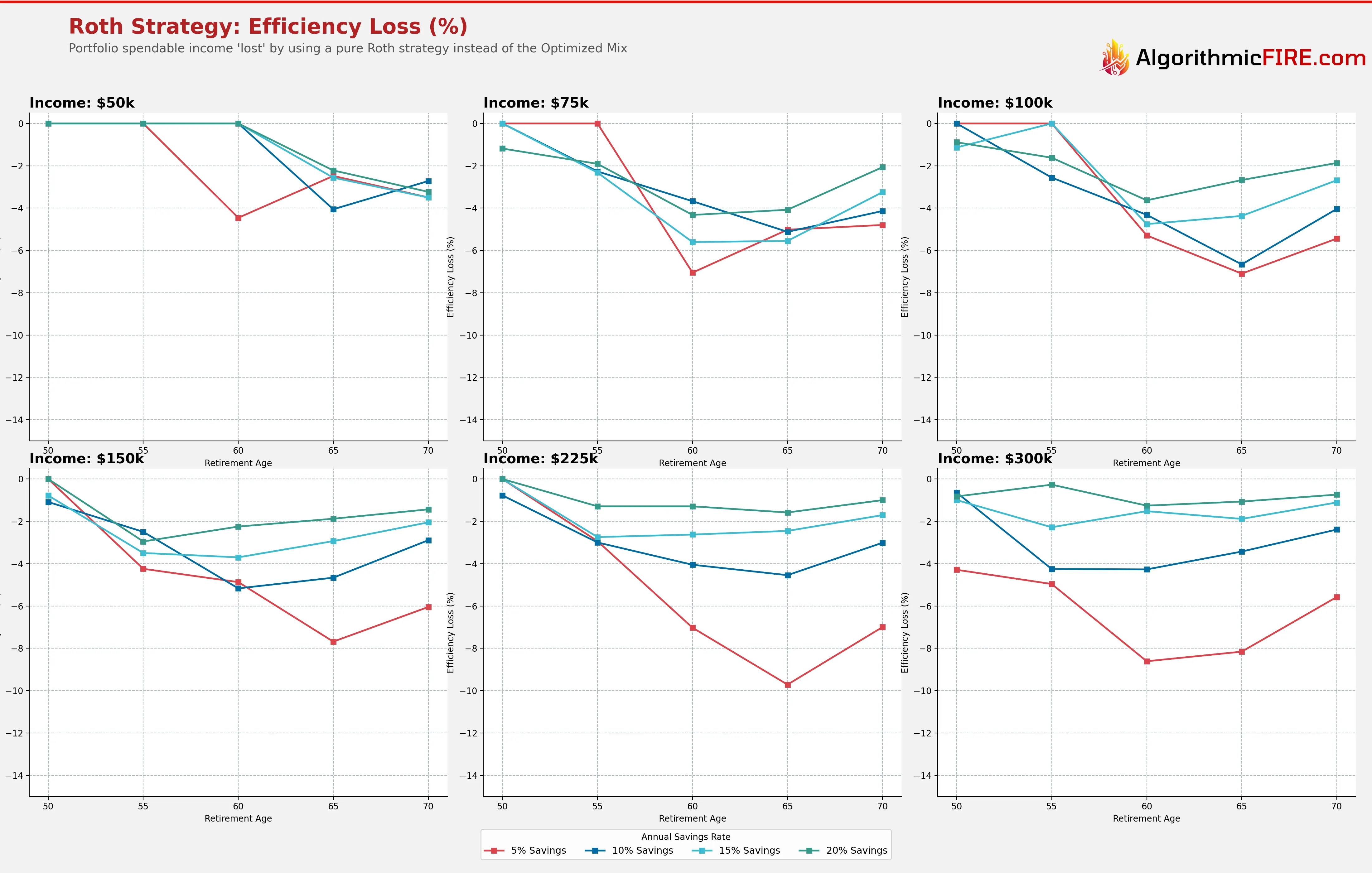
Across nearly every solvent scenario, committing purely to Roth leaves spendable cash on the table:
Concrete Scenario Breakdown
For a household starting at $150,000 income (retiring at age 65 with a 5% savings rate):
- 100% Traditional sustainable spend: $45,404/year
- 100% Roth sustainable spend: $34,097/year
- Roth Spending Shortfall: -24.9% — $11,307 per year left on the table (over $339,000 across a 30-year retirement).
For a household starting at $300,000 income (retiring at age 65 with a 15% savings rate):
- 100% Traditional sustainable spend: $231,709/year
- 100% Roth sustainable spend: $207,580/year
- Roth Spending Shortfall: -10.4% — $24,129 per year left on the table.
5. The Early Retirement ACA Twist: Where a Hybrid Strategy Wins
A critical question arises from this analysis: What if you start in Traditional in your 30s and switch contributions to Roth at age 45 or 50 as your income, marginal tax bracket, and balances grow?
To investigate this, I ran an accumulation parameter sweep simulating working careers from Age 35 to retirement across our cohorts. The simulation tested switching contributions from Traditional to Roth at 3-year intervals (Ages 35, 38, 41, 44, 47, 50, 53, etc.) and solved for the maximum sustainable lifetime retirement spending for each resulting portfolio.
The findings reveal two distinct regimes depending on your target retirement age:
Regime A: Retiring at Medicare Age (65+)
For households retiring at age 65 across starting incomes of $50,000–$300,000 and 5%–20% savings rates, the sweep was strictly monotonic: switching contributions to Roth at any age during your working career reduced lifetime sustainable spending compared to staying 100% Traditional.
Why does 100% Traditional dominate at age 65?
- Peak Career Deductions: Late-career contributions deduct income at your highest marginal brackets (24%–32%+). Forfeiting that deduction to deposit after-tax dollars severely reduces the compounding principal entering your accounts.
- Long Decumulation Runway: At age 65, Medicare begins immediately, eliminating pre-65 ACA subsidy cliffs or MAGI phase-out penalties. For the next 30 years (ages 65 to 95), every dollar of Traditional distributions fills progressive brackets from the bottom up—starting with the $35,500+ senior standard deduction at a 0% effective tax rate, followed by the 10% and 12% brackets. Because career marginal deductions (24%–32%) far exceed retirement effective rates (0%–15%), staying 100% Traditional delivers maximum tax arbitrage.
Regime B: The Early Retirement (Pre-65) ACA Sweet Spot: Where a Hybrid Mix Wins
However, for early retirees retiring well before Medicare (such as Age 55) who must navigate 10 years of private health insurance on the ACA marketplace, healthcare subsidies flip the optimal balance to a hybrid strategy.
Consider a representative early retirement case: a household starting at $150,000 income at age 35, saving 20%, and retiring at Age 55 (where earnings reach ~$310,000, facing 10 years of ACA coverage from age 55 to 64):
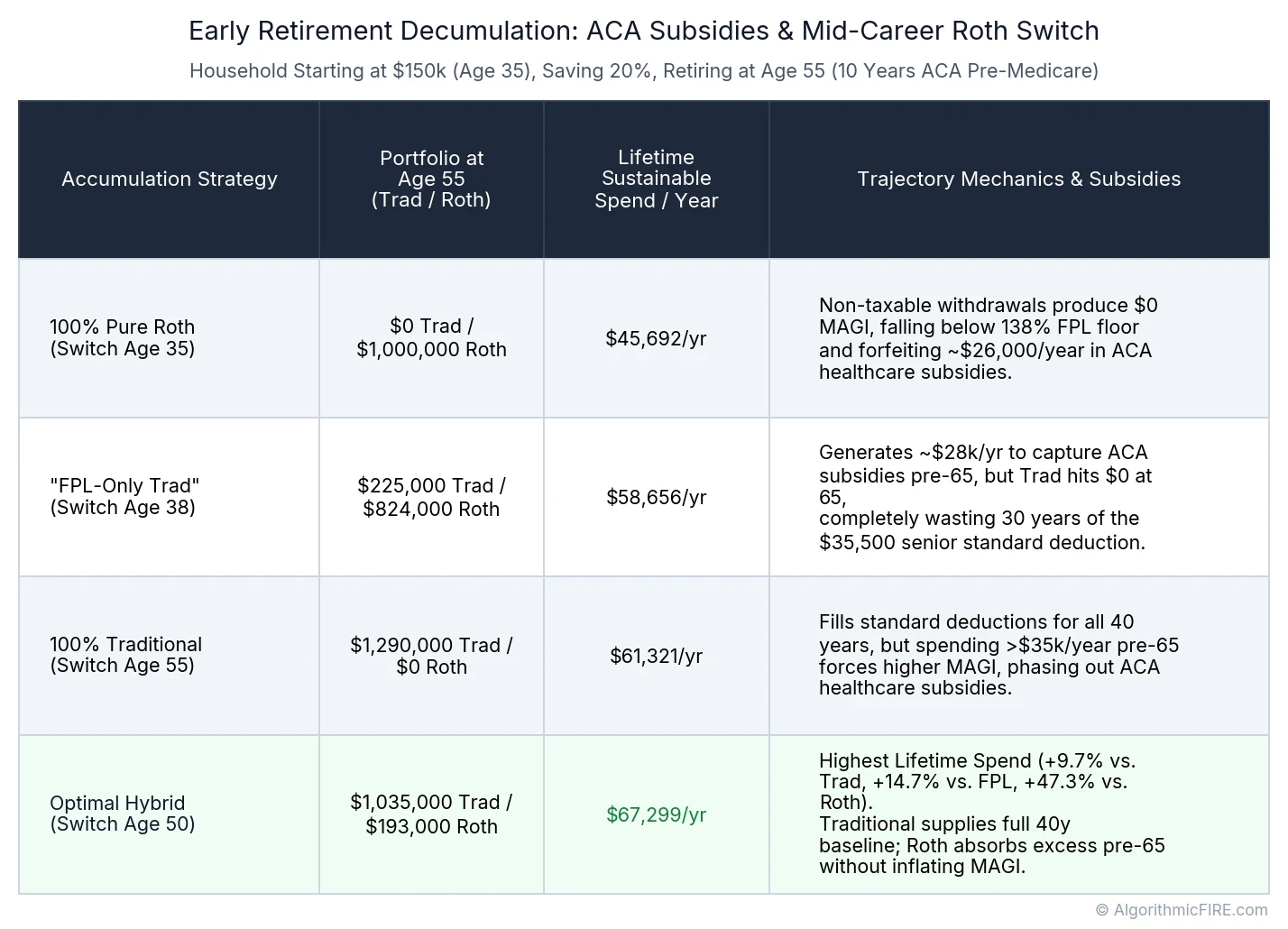
Why "Just Enough Trad for FPL" Leaves Money on the Table
A common intuition is: "If ACA subsidies require MAGI between 138% and 200% FPL, why not accumulate just enough Traditional to reach that threshold (~$28,000/year for 10 years = ~$280,000) and save the rest in Roth?"
As the table demonstrates, that approach yields only $58,656/year—which is actually inferior to 100% Traditional ($61,321/year).
The flaw lies in what happens after age 65. In the "FPL-only Trad" simulation, the Traditional balance reaches exactly $0 by age 65. For the remaining 30 years of retirement (ages 65 to 95), the retiree is forced to fund 100% of their living expenses from Roth. That means for 30 consecutive years, the household's $35,500+ annual senior standard deduction (a literal 0% federal tax bracket) goes completely unused. Over a 30-year decumulation, that is over $1,060,000 in tax-free deduction capacity completely thrown away. The household paid 22%–24% upfront taxes in their 30s and 40s to fund Roth balances that will be spent in their 70s and 80s when they could have withdrawn those same dollars completely tax-free.
The Mechanics of the Optimal Hybrid Portfolio
The optimal solution balances both horizons:
- Long-Term Standard Deduction Anchor: You need a substantial Traditional balance (~$1.0M) to continuously fill the 0% standard deduction and low progressive tax brackets across your entire 40-year retirement horizon (Ages 55 to 95).
- Pre-Medicare Lifestyle Buffer: You need a targeted Roth bucket (~$190,000) to fund living expenses above the optimal ACA subsidy ceiling during the 10 pre-Medicare gap years (Ages 55 to 64).
Between ages 55 and 64, the retiree draws ~$28,000–$30,000/year from Traditional to capture maximum ACA healthcare subsidies, while drawing the remaining ~$37,000/year of lifestyle spending from their Roth reserves completely tax-free and subsidy-free. Once Medicare begins at age 65, Traditional distributions step up to ~$71,000–$75,000/year, filling the $35,500 standard deduction at 0% tax and low brackets for the remainder of life.
💡 Model Your Own Retirement Mix: You can test your specific retirement age, current Traditional and Roth balances, and target spending using the interactive Roth Conversion & ACA Cost Optimizer to locate your household's optimal conversion corridor and healthcare subsidy eligibility.
6. Real-World Stress-Test: Integrating Social Security at Age 67
If you assume statutory Social Security benefits remain fully funded and payable under current rules, how does guaranteed lifetime income starting at age 67 affect the choice between Roth and Traditional?
To test this, I re-ran the full 120-scenario lifecycle grid using statutory Social Security benefits claimed at Full Retirement Age (67). Career earnings prior to age 35 were modeled flat at the initial wage baseline, with 3.7% annual real wage growth from age 35 to retirement (capped annually at the statutory OASDI wage base).
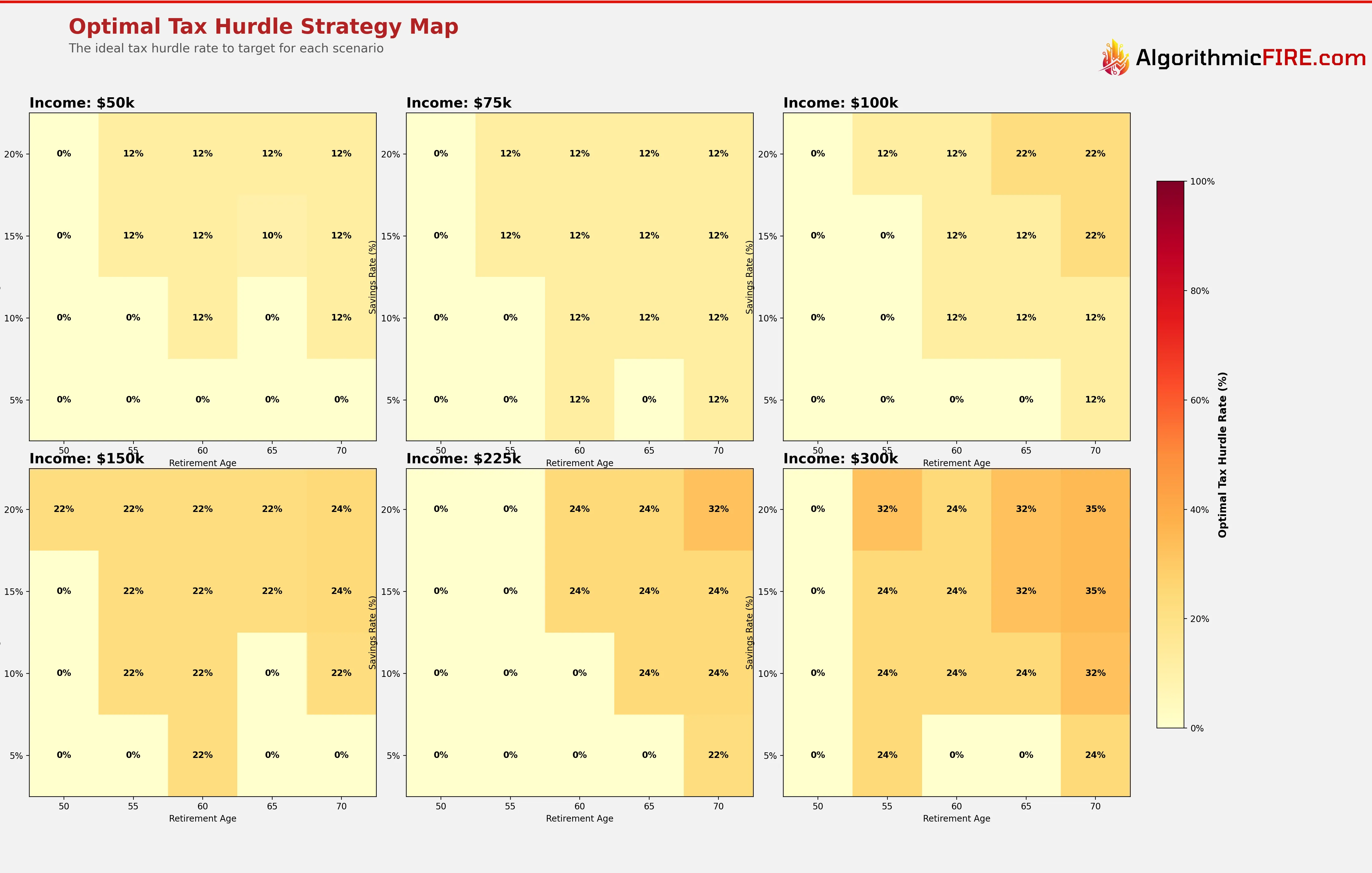
The chart below plots the sustainable annual retirement spending ceiling when Social Security is claimed at age 67:
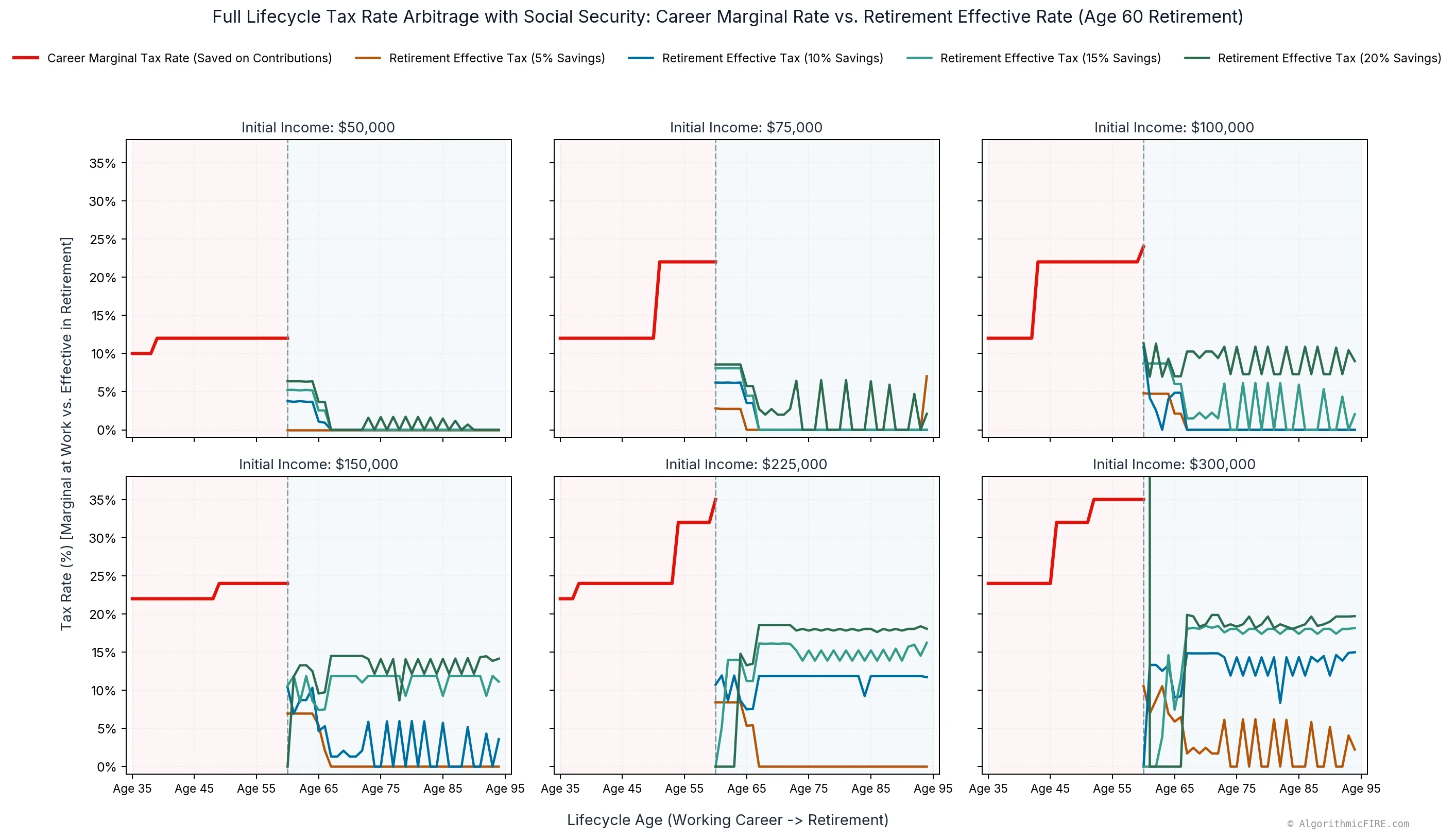
And the corresponding full lifecycle tax arbitrage trajectory with Social Security:
Key Findings with Social Security
- Higher Absolute Spending Power & Solvency: Guaranteed Social Security inflows ($33,000–$78,000/year household) add a substantial lifetime income floor, expanding the number of solvent retirement paths from 111 to 112 out of 120.
- Social Security Fills Lower Brackets: Because Social Security benefits fill the standard deduction and low progressive brackets after age 67, Traditional distributions sit higher on the tax curve. The proportion of scenarios with an effective retirement tax rate ≤ 10% shifts from 84.7% to 39.3%, and ≤ 15% shifts from 91.9% to 73.2%.
- Traditional Still Retains the Spending Advantage: Even with higher realized taxes in retirement, Traditional IRA delivers higher sustainable spending across nearly all solvent cases:
- $150,000 starting income (Age 65 retirement, 5% savings): Traditional provides $109,071/year vs. $101,221/year for Roth (+7.8% Traditional advantage, or a -7.2% Roth shortfall).
- $300,000 starting income (Age 65 retirement, 15% savings): Traditional provides $286,226/year vs. $275,553/year for Roth (+3.9% Traditional advantage, or a -3.7% Roth shortfall).
- Why Traditional Wins Even With Social Security: Deducting contributions at a 22%–32%+ marginal rate during peak career earnings leaves significantly more principal compounding in the portfolio. In retirement, even with Social Security filling lower brackets, the overall effective tax rate on Traditional distributions (7.0% to 20.8%) remains lower than the marginal rate saved during accumulation.
7. The Boundary Conditions: When Roth Dominates
It is critical to emphasize that these findings apply to households with starting incomes of $50,000–$300,000 at age 35 and savings rates of 5%–20% modeled in this study.
When does Roth accumulation become mathematically optimal?
- Incomes Exceeding $400,000+ & Savings Rates of 30%+: When high earners accumulate $5,000,000 to $8,000,000+ in pre-tax balances, future Required Minimum Distributions (RMDs) at age 75 alone exceed the 32%–37% federal tax brackets and trigger Tier 4 or Tier 5 Medicare IRMAA surcharges. In these ultra-wealth scenarios, late-career Roth contributions and aggressive tax diversification are necessary to preempt the downstream RMD tax bomb.
- Large Defined-Benefit Pensions: If a retiree receives a substantial guaranteed pension (e.g., $60,000–$100,000+/year) that permanently fills the standard deduction and low progressive tax brackets from day one of retirement, Traditional distributions are pushed into higher marginal brackets.
- Mega-Backdoor Roth Access: For high-saving households who have already maxed their statutory $23,500/year ($46,000 for couples) pre-tax 401(k) deduction, saving additional dollars into an after-tax mega-backdoor Roth is vastly superior to a taxable brokerage account because it eliminates ongoing tax drag on dividends and capital gains.
8. The Actionable Playbook
- Traditional is the stronger default: For typical households with starting incomes between $50,000 and $300,000 at age 35 saving within standard 401(k) limits, Traditional IRA delivers higher sustainable retirement spending. Committing purely to Roth leaves between 10% and 25% of spendable cash on the table.
- Early retirees need a targeted hybrid mix: If you plan to retire before Medicare at age 65, pair a dominant Traditional balance (~$1.0M) to anchor lifetime 0% standard deductions with a targeted Roth pool (~$190k) to fund lifestyle spending above the ACA subsidy corridor pre-65 without inflating MAGI.
- Target strategic brackets over exact pennies: Decumulation models define optimal multi-year conversion corridors and target tax brackets rather than rigid, penny-exact scripts. Review your actual income in December and convert up to your target bracket ceiling.
- Decumulation Mechanics Note: If the sustainable retirement spending figures throughout this analysis appear higher than expected (e.g., ~$110,000–$130,000/year on a ~$2M nest egg), this stems directly from separating tax vehicle optimization from sequence of returns risk. In this study, I used a constant 5.0% real return (0 volatility) amortizing balances down to $0 at age 95. At 5% real interest plus principal amortization, baseline cash flow is ~5.6% to ~7.1% before taxes, whereas safe withdrawal rate rules (like the 4% rule) are designed to survive historical worst-case market crash sequences.
- Test your specific numbers: Project your own expected balances, spending targets, and retirement age using the interactive Traditional IRA Withdrawal and Roth Conversion Calculator.
Tax regulations are fluid and subject to legislative changes. This post uses simulated results across explicit modeling assumptions to identify broad patterns. Your personal situation—state taxes, pension income, and other factors—will affect your specific outcome. This is not tax advice. Please consult a qualified tax and investment professional before making financial decisions.