Considering retiring early, but worried about healthcare (ACA) costs?

With some financial engineering, you can reduce (and possibly eliminate) the cost of ACA coverage.

Video Summary

Premium Subscriber Content

We will show you how to reduce (and possibly eliminate) the cost of ACA coverage by balancing your traditional and Roth IRA contributions and subsequent withdrawals. Doing so will allow you to generate specific amounts of income, which will allow you flexibility in managing your MAGI (Modified Adjusted Gross Income) to minimize your ACA costs. This is more complex than it seems, because the subsidies have both a floor and a ceiling that need to be avoided.


The Problem

ACA health insurance can be expensive. If you go to the ACA Marketplace and enter your information, you will see that the cost of coverage varies depending on your income. Unsubsidized premiums range from roughly $1000 to $1300 per month for a 60 year old. That is $12,000 to $15,600 per year.

The key word in that last paragraph is "unsubsidized". There are ACA subsidies available to reduce the cost of coverage. The amount of subsidy you receive depends on your income. The lower your income, the higher your subsidy. The formal name for these subsidies is Premium Tax Credits (PTC).


The Solution

The key in all of this is to realize that you can control your MAGI by controlling how much you withdraw from your traditional IRA. You can then use cash or Roth IRA withdrawals to close the gap between your MAGI and the amount needed to fund your lifestyle. The key here being that cash and Roth IRA withdrawals do not count as income for MAGI purposes. (You've already paid tax on cash and Roth IRA withdrawals; there is no reporting.)

We are going to use our new Traditional IRA Withdrawal and Roth Conversion Calculator to show how this works. But first, we need to understand the cliffs that we need to avoid.


The Cliffs

There are two cliffs that you need to be aware of when it comes to ACA subsidies (a.k.a. Premium Tax Credits, or PTC). Both are based on the Federal Poverty Level (FPL).

  1. The Medicaid Eligibility Cliff (100%-138% of FPL) - If you are eligible for Medicaid, you are not eligible for PTC.
  2. The 400% FPL Cliff - If you are above 400% of FPL, you are not eligible for PTC.

For tax year 2025, the federal poverty level is $15,060 for a 1 person household, and $5380 for each additional person. This is for the 48 contiguous states; Alaska and Hawaii have slightly higher FPL.

The reason there is a range for the Medicaid Eligibility Cliff is because some states have expanded Medicaid coverage, while others have not. (Medicaid coverage is determined by states, not the federal government.) So the federal government has set PTC eligibility based on a combination of Medicaid coverage eligibility and the federal poverty level.

It is important to note that the 400% FPL cliff is actually a cliff; there is no phase-out of coverage.

For more details on PTC, see the IRS Premium Tax Credit (PTC) Overview and IRS Form 8962, Premium Tax Credit (PTC).

You will note that IRS Form 8962 only mentions the 100% FPL floor, because that is the federal legal minimum for Premium Tax Credit (PTC) eligibility. The IRS uses 100% FPL as the baseline because, federally, anyone between 100% and 400% FPL is technically "eligible" for tax credits. However, the law also says you cannot get a tax credit if you are eligible for Medicaid. And that limit, as described above, is 138% of FPL in states that have expanded Medicaid.


Summary of PTC Eligibility

For States WITHOUT Expanded Medicaid Coverage (AL,FL,GA,KS,MS,SC,TN,TX,WI,WY)

  • PTC available IF income is > 100% of FPL
  • Medicaid eligibility is typically based on categorical requirements—meaning you must fall into a specific group (like being a parent or having a disability) in addition to having an extremely low income.

For States WITH Expanded Medicaid Coverage (states not listed above)

  • Medicaid eligible if income is <= 138% of FPL
  • PTC available IF income is > 138% of FPL
    • If you purchase ACA coverage with income <= 138% of FPL, you are not eligible for PTC and will pay full price.

Summary Table: Who Pays for What?
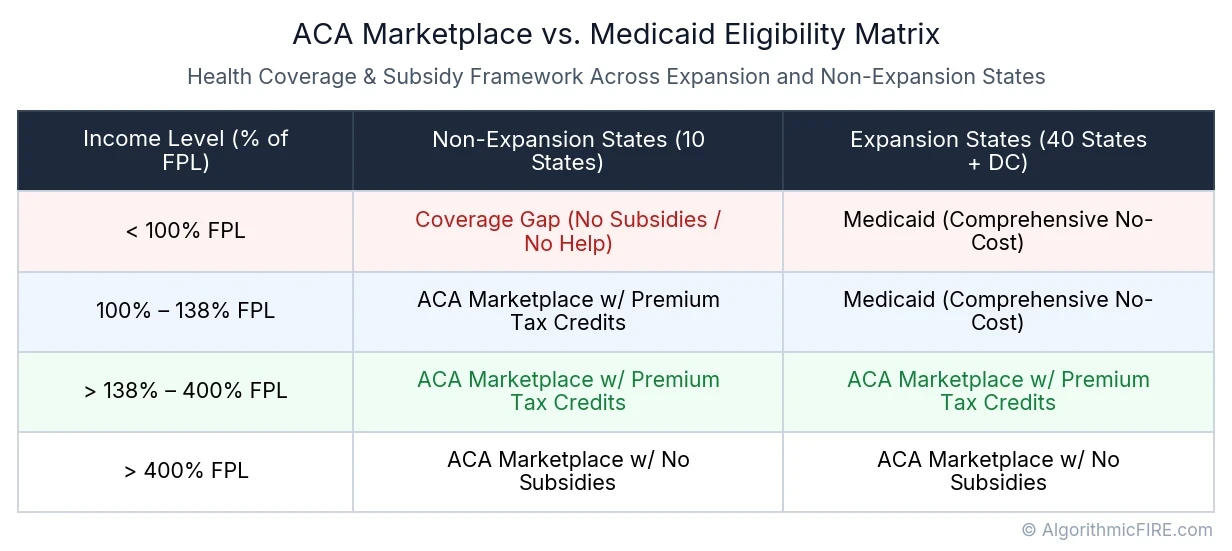
Income Level Non-Expansion States Expansion States
< 100% FPL Coverage Gap (No help) Medicaid
100% – 138% FPL ACA w/PTC Subsidies Medicaid
> 138% FPL ACA w/PTC Subsidies ACA w/PTC Subsidies
> 400% FPL ACA w/No Subsidies ACA w/No Subsidies

Case Studies

Let's look at two examples to see how this works. In both cases we will pick account balances that are projected to just make it to their end of life. This was done to show exactly how money in only a traditional IRA compares to money in a combination of traditional and Roth IRAs. Returns are also assumed to be constant, which is not realistic, but it does allow us to isolate the impact of the ACA subsidies. Sequence of returns risk is thus ignored and makes both cases more optimistic than they would be in reality.

In both cases we will assume the following:

  • Retiring at current age of 60
  • Target spend: $100,000 per year (this is total disposable income)
  • Filing status: Married Filing Jointly
  • Social security income of $80K starting at age 67
  • Real return: 4%
  • State: CO (our model ignores state tax - the state is only important for considering Medicaid eligibility)
  • ACA premiums: $14,000 per year per person
  • FPL is $81,760
  • Medicare base premium: $2,400 per year per person

Friction Cost - Analysis and charts below refer to "friction cost", which is the sum of federal tax paid and health care premiums paid minus PTC.

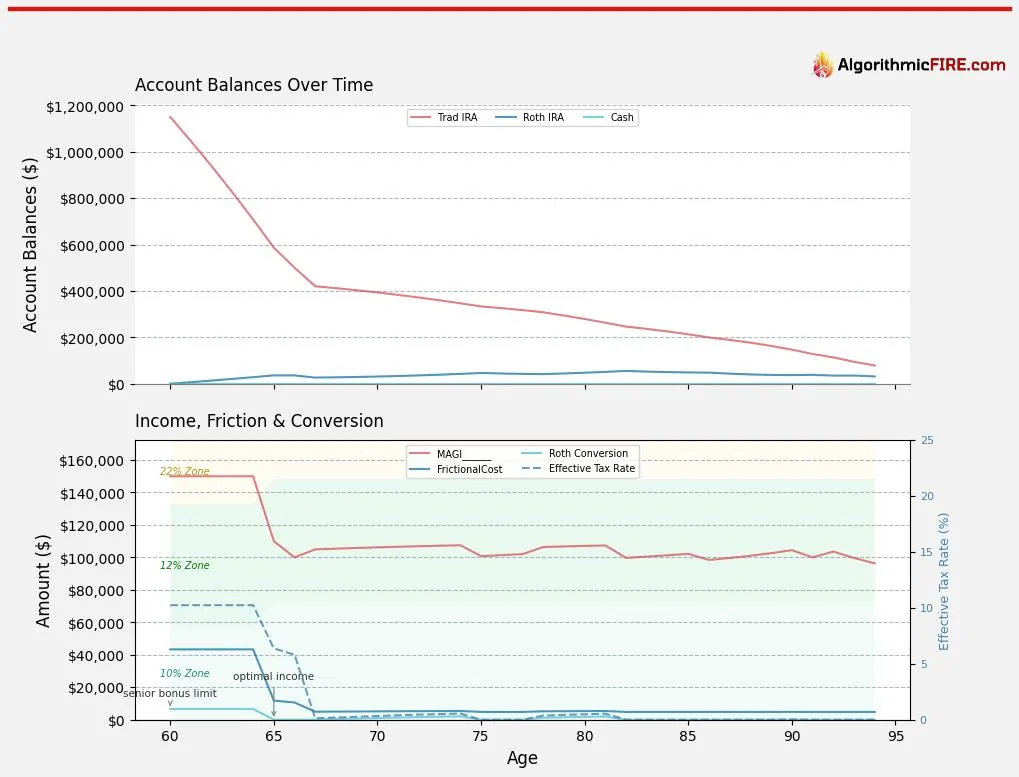
Case 1 - Traditional IRA Only: $1.15M

This is the baseline case, showing what you want to avoid. This chart was created using the Traditional IRA Withdrawal and Roth Conversion Calculator, with inputs shown above, and "Enable Multi-Year Lookahead Optimization" was not checked. (We also removed some optimizations from the model to generate this particular chart.)

Key points:

  • The first 5 years, prior to being eligible for Medicare, the ACA premiums are $14,000 per year per person, or $28,000 per year total.
  • Total friction cost is $43,340 each year.

Because the only method to generate spending money is to withdraw from your Traditional IRA, and that is taxable income, this example shows MAGI well exceeds 400% of FPL. The result is that the couple is not eligible for any ACA subsidies.

image_1.jpg

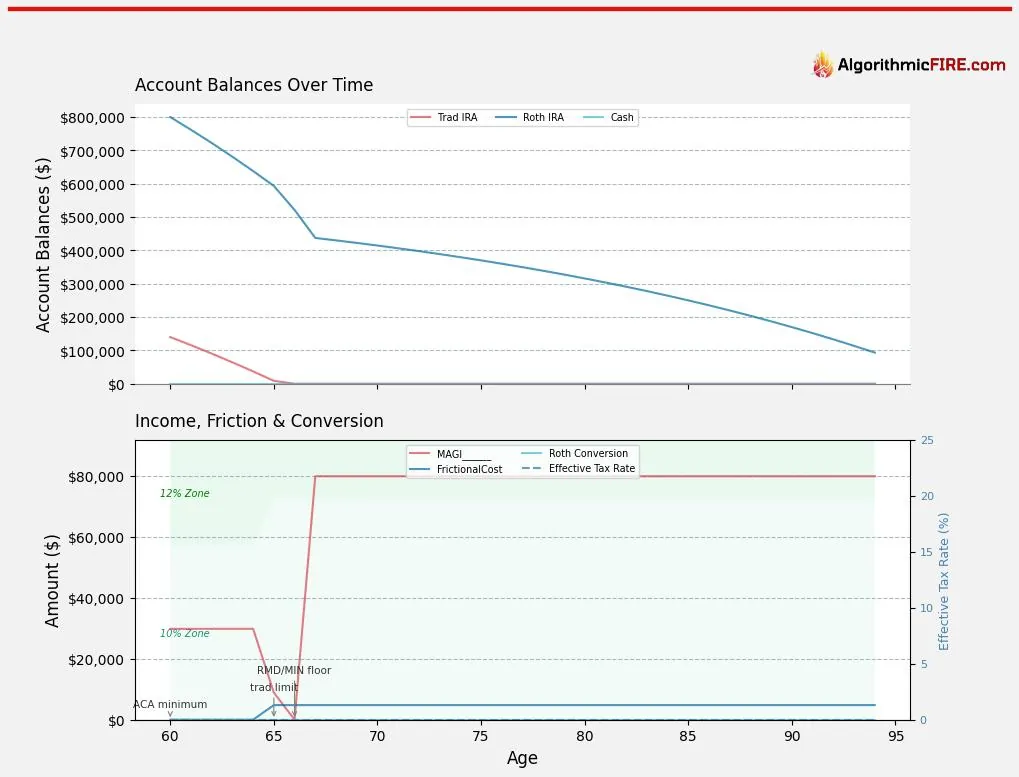
Case 2 - Traditional IRA: $140K, Roth IRA: $800K

The only thing we will change for this example are the starting account balances. Now the couple has $140K in Traditional IRA and $800K in Roth IRA. Note that the $140K in the traditional IRA was chosen to be the minimum amount needed in order to generate the required MAGI to avoid the Medicaid cliff.

Key points:

  • Prior to age 65, the couple is pulling just enough money from the traditional IRA to generate the MAGI needed to avoid the Medicaid cliff, and using Roth IRA withdrawals to make up the difference in spending needs.
  • For the first 5 years, the couple is eligible for PTC that covers 100% of their ACA premiums.
  • Total friction cost is $0; they are paying no federal tax and no ACA premiums.
  • At age 65, they are eligible for Medicare, and their frictional costs increase to $4,800 per year to cover Medicare premiums.

image_2.jpg


Comparing the Two Cases

At first glance, Case 2 looks much better than Case 1. But let's look at the total amount of money left at the end of the simulation.

  • Case 1: $66K in the traditional IRA and $24K in the Roth IRA.
  • Case 2: $72K in the Roth IRA.

Given that the case 1 income is low enough that it is generally paying zero federal tax, this compares as follows:

  • Case 1: $90K in total.
  • Case 2: $72K in total.

If the federal tax rate was higher we would need to discount the traditional IRA balance by unpaid taxes. But given the income, and current high levels of both standard deductions AND senior bonuses, there is no federal tax for case 1.

Do These Cases Compare Apples to Apples?

If we assume that the couple in case 2 is in the 22% marginal tax bracket, then saving $800K in the Roth IRA took $1,025,641 in pre-tax income. Thus the couple in case 2 spent about $1,165M ($1,025 + $140K in the traditional IRA) in pre-tax income to generate their balances, while the couple in case 1 spent $1.15M in pre-tax income to generate their balance. The difference is only about $15K in pre-tax income.

So these cases are pretty comparable. Each couple would have had about the same after tax income over the years.

Who Wins?

You might think that the couple in case 2 would be better off, but they are not.

The total difference: couple 1 saved $15K less than couple 2, and ended up with $18K more in purchasing power at death, for a net difference of $33K in favor of couple 1. The traditional IRA couple won?

The reason is subtle - couple 1 funded their retirement with pre-tax dollars, then paid almost no income tax on their withdrawals, due to deductions. (That compares to couple 2, who paid federal income tax on their contributions, and thus started with a lower balance.) In the end, the difference between the two couples is negligible.

IF the couple in case 2 were in a higher tax bracket, then the traditional IRA couple would have won. Conversely, if the couple in case 2 were in a lower tax bracket, then the Roth IRA couple would have won.

This result is specific to this example, and does not generally indicate that one type of IRA is better than the other. It is simply a result of the specific numbers used in this example.

This highlights an important point regarding deductions: the standard deduction is currently (tax year 2025) $31.5K. Once age 65 and over, the senior bonus adds another $6K, and that is in addition to the senior deduction add-on of $1.5K. The net result is a total of $39K in deductions.

We will be writing a future post that explores more issues around traditional versus Roth IRA performance. In the meantime, try our Traditional IRA Withdrawal and Roth Conversion Calculator to see how different account balances and withdrawal strategies affect your tax liability, PTC, and more.


Actually - the Traditional IRA Couple Won

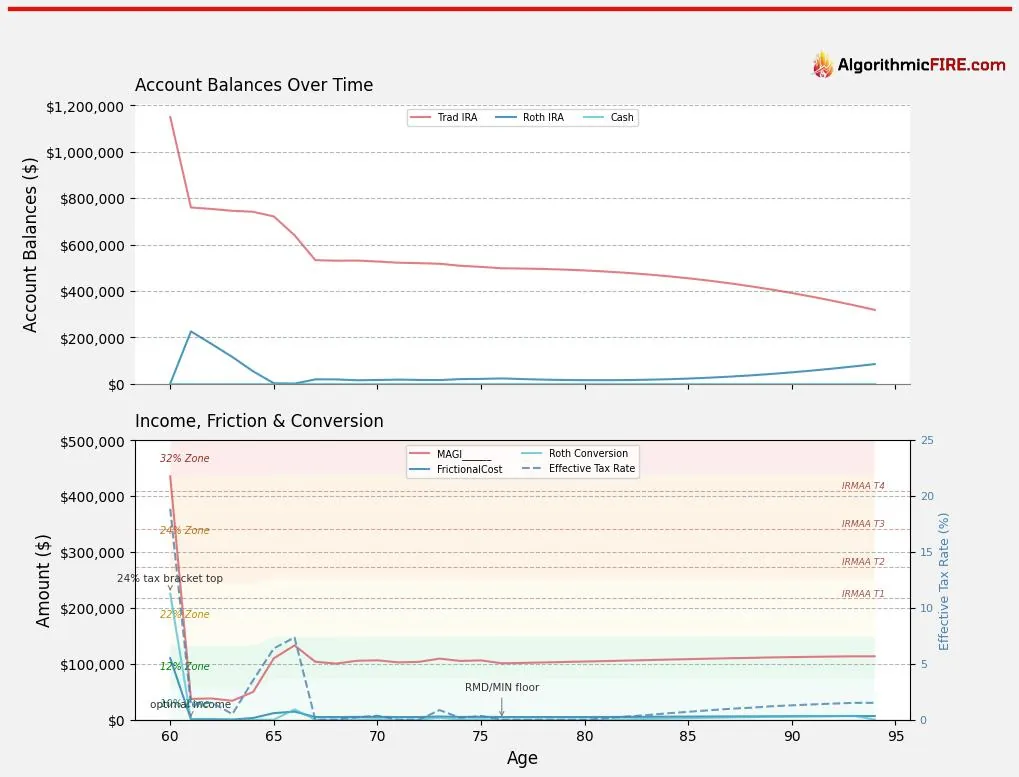
We noted that in the above scenarios "Enable Multi-Year Lookahead Optimization" was not checked. We wanted to start with a simple example, that might be both easier to understand, and show a mistake many people might make.

That said, let's see what happens when we turn multi-year lookahead optimization on.

Enable Multi-Year Lookahead Optimization - This is a subscriber only feature that allows the optimizer to look ahead many years to make decisions. It is a more computationally expensive option, but it can lead to better results.

image_3.jpg

In this case the multi-year lookahead optimization results in the couple ending up with $298K in their traditional IRA and $88K in their Roth IRA at death. This compares to the $90K in total that they ended up with when the multi-year lookahead optimization was not enabled. The difference (reducing the traditional IRA balance by the current federal tax rate of about 5%) is $280K in favor of the multi-year lookahead optimization. The traditional IRA couple won

What happened? The optimizer was able to look ahead, and realize that by taking a large up-front withdrawal from the traditional IRA and converting that into the Roth IRA, it could take smaller distributions in later years, and optimize the PTC (ACA subsidies).


The Caveats and Questions

  • With a traditional IRA, you can't start making withdrawals until age 59.5, or you will be subject to a 10% penalty. (This is not true for Roth IRAs.) So this strategy is ideal for someone who is retiring at or after age 59.5.
    • That said, there is an exception for SEPP (substantially equal periodic payments), but that is a complex topic that we will not be covering in this post. If you want to use this strategy earlier than age 59.5, you should learn about SEPP and consult with a tax professional.
  • With a Roth IRA you cannot withdraw conversions for 5 years, or you will be subject to a 10% penalty, unless you are 59.5 or older. (This is not true for contributions.) The model does implement this rule. That said, be careful when planning. If you are planning on using this strategy, you need to make sure that you don't need to access your converted funds for 5 years or until you reach age 59.5 or older.
  • You can also use this strategy while working to reduce health care costs, while you utilize your Roth IRA to boost your spendable income. This would work well for someone who saves a lot of money early in their career, and then moves into a lower paying position, starts their own business, or otherwise reduces their income.
  • You will need to be aware of capital gains on any transactions in your taxable accounts, and similarly aware of dividends or other income that you may receive. All of these impact your MAGI, and therefore your PTC/ACA subsidies.
    • You may trigger income from any of these sources, not just traditional IRA withdrawals, which was the focus of this post. If you have assets in taxable accounts, and generate capital gains and/or dividends, be sure to account for those in your MAGI.
  • Can this strategy be used to take a short career break?
    • Maybe - the issue is that PTC is determined by MAGI in the previous year.
      • If your break is for a full year, or your income such that during the part of the year you are working you can still manage your MAGI to be below 400% of FPL, then this strategy could work.
      • But if your MAGI for the first part of a calendar year is over 400% FPL, then you stop working until the end of that year, you will have no PTC in that year as you exceeded the 400% FPL threshold.
      • Again - consult a tax professional if you are considering this strategy.
  • The utility of calculators like ours is not to create a long term Roth conversion plan. The utility is to get a sense of how different account balances and withdrawal strategies affect your tax liability, PTC, and more.
    • That is because you need to have a rough idea how much frictional costs you will be subject to when in retirement, in order to plan how much you need to save. As we saw in the example above, the difference between no strategy, and a more optimal strategy, can be a significant amount of money.

Don't hate the player, hate the game

There is a moral dilemma that we feel needs addressed. We've discussed how we can use the tax code to our advantage. But is it right to do so? In discussions with friends and family, the first reaction is often "is it right for people with $1M+ in assets to be getting subsidies for healthcare?". In fact, that was our first reaction too; "just because you can, doesn't mean you should" is what came to mind.

But the system we have allows for this, as well as many other things that we may not agree with. I.E. allowing corporations to shift profits to low tax jurisdictions in other countries, or allowing very rich people to avoid taxes altogether by borrowing against their assets. Ultimately, we have to decide what is right for us, and what we are comfortable with. For us, we think the right answer is: use the tax code to our best advantage, and vote for politicians who will make changes we agree with. "Don't hate the player, hate the game" is a common saying that applies here.


Takeaways

  • ACA subsidies can significantly reduce the amount you pay for healthcare.
  • Having money in both a traditional IRA and Roth IRA allows you control over your MAGI, which can be used to optimize your ACA subsidies.
  • You can use our Traditional IRA Withdrawal and Roth Conversion Calculator to see how different account balances and withdrawal strategies affect your tax liability, PTC, and more. (But to get the full benefit of the calculator, you need to use the multi-year lookahead optimization.)
  • Tax issues are complex, and frequently change.
    • The subsidies could go away at any time.
    • The standard deduction could change.
    • The senior bonus could change.

Tax issues are complex. This post uses many simplifications and assumptions to make the argument clear regarding how MAGI can be controlled to optimize ACA subsidies. This post is meant to give you some starting information and help you understand the tax issues involved. But your personal situation will not be the same as our hypothetical married couple. You need to understand your own personal situation before making any decisions. This post is not tax advice. Please consult a tax professional before making any decisions.


Ready to learn more?

See a list of recent blogs on our home page.

Or, dive deeper into investing, saving, and withdrawal strategies through our comprehensive Curriculum.

Subscribe now to get:

  • Our new blogs delivered straight to you via email.
  • Access to all historical blogs. (Only recent posts are availble to non-subscribers.)
  • Access to videos and all of our calculators.
  • Access to all blog content as a downloadable PDF.
  • Access to our Dashboard with trend following results.

Thanks for reading! Feel free to share this post, and follow us on social media:

Bluesky Yahoo Finance Share

Disclaimer

**For Educational Purposes Only:** All content on this site, including articles, tools, and simulations, is for informational and educational purposes only. It should not be construed as financial, investment, legal, or tax advice. The information provided is general in nature and not tailored to any individual’s specific circumstances.

**Software Development Has Inherent Risks:** The software used to perform the analyses may have errors or inaccuracies. When we post updates to any material, errors or inaccuracies that are subsequently fixed may change the results.

**No Guarantees & Risk of Loss:** The analyses and simulations presented are based on historical data. Past performance is not an indicator or guarantee of future results. All investing involves risk, including the possible loss of principal. Market conditions are subject to change, and the future may not resemble the past.

**No Fiduciary Relationship:** Your use of this information does not create a fiduciary or professional advisory relationship. We are not acting as your financial advisor.

**Consult a Professional:** You should always conduct your own research and due diligence. Before making any financial decisions, it is essential to consult with a qualified and licensed financial professional who can assess your individual situation and objectives. We disclaim any liability for actions taken or not taken based on the content of this site.

* Nobody associated with Algorithmic Fire LLC has any credential(s) or affiliation(s) with any licensing or regulatory bodies, including but not limited to: Securities and Exchange Commission (SEC), Financial Industry Regulatory Authority (FINRA).

© 2025-2026 Algorithmic Fire LLC. All rights reserved.


View Video Transcript
Okay, if you're even thinking about an early retirement, there's this one giant cost that can just totally blow up your plans. But what if I told you there's a way to not just handle it, but to actually turn the whole system to your advantage? We're talking about a move that could be worth hundreds of thousands of dollars. Yeah. Let's get into it. First, you have to get your head around this number. $28,000. For a 60-year-old couple, that can be the annual bill for health insurance on the ACA marketplace if you don't get any help. And that's before you've even seen a doctor. It's it's a huge number. I mean, just think about it. An unexpected bill that size year after year, it's absolutely devastating for most people. It's the kind of thing that makes you rethink everything. Maybe you can't retire after all. Maybe you have to go back to work. It's a real threat to that freedom you've spent decades working for. But, and this is a big butt, there is a way around it. The real secret isn't about just sucking it up and paying the bill. It's about playing the game so you don't have to. It's about understanding how the Affordable Care Act subsidies actually work. See, the whole system really boils down to just one number. And the trick is learning how to control it. And that allimportant number is your modified adjusted gross income or MAGI. It's a bit of a mouthful, I know, but just think of it as the government's official measuring stick for your income when it comes to healthcare. And here's the crazy part. In retirement, you actually have a ton of control over what that number is. In this right here, this is the secret sauce. This is how you pull the levers. When you take money out of a traditional IRA, boom, that counts as income. It pushes your magi up, but money from a Roth IRA, nope, doesn't count at all. You already paid tax on it. That one little difference is the key that unlocks this entire strategy. So, the whole game is about keeping your Magi in that perfect sweet spot. If you look at this table, you can see there are these like cliffs. If your income is too low, you might end up with no help at all or on Medicaid. If your income is too high over what they call 400% of the federal poverty level, poof, your subsidies just vanish. The goal is to carefully thread the needle and land right in that zone where you get the most help. All right, to really see how this works, let's tell a story. A tale of two couples. On the surface, they look almost exactly the same, but under the hood, their financial strategies are completely different. This is where it gets really interesting. So, here's the setup. Both couples hang it up at age 60. They both figure they need about a h 100red grand a year to live the life they want. And they both started with pretty much the same amount of money saved. The only, and I mean only difference is what kind of retirement account they used. One couple is all in on a traditional IRA while the other has a mix of a traditional and a Roth. And right out of the gate, the difference is well, it's jaw-dropping. Couple number one, the all traditional IRA folks, they have to pull out that full $100,000 they need. That whole amount counts as income, which sends their magi through the roof and pushes them right off that subsidy cliff. They end up paying over $43,000 a year in taxes and insurance premiums. Couple number two, our Roth mix couple. They play it smart. They only pull a little from their traditional IRA to keep their income low, take the rest from their Roth tax-free, and they end up paying zero. A big fat zero. So based on that, you'd think case closed, right? The winner is obvious, but this is where the story takes a really weird, unexpected twist. Let's hit the fast forward button, go to the end of their lives, and see who actually finished the race with more money. I mean, come on. It has to be them, doesn't it? They paid nothing for years, while the other couple was shelling out over 40 grand a year. It's a no-brainer. Okay, let's look at the final score. Couple number one, the ones who were paying all those crazy premiums, they finished with a net worth of $90,000. And couple number two, the smart ones who paid zero in premiums, they ended up with just $72,000. They have less money. So, what on earth happened? It's kind of a sleeper effect. The traditional IRA couple got a tax break on their contributions for years. Then when they retired, the standard deduction was so high that they ended up paying very little tax on their withdrawals anyway. It was a subtle advantage, but it added up. They came out ahead by about 18,000 bucks. But wait, hold on. That was the simple version. That's what happens when you just kind of let things play out. What if our winning traditional IRA couple had been a little more strategic? What if they'd made one big powerful move right at the beginning? Let's see what happens when they go from just playing the game to absolutely mastering it. See, this is the difference between just reacting year to year and having a real proactive plan. This is about thinking five steps ahead to set up the chessboard perfectly. And here it is, the master stroke. In their very first year of retirement, they do what's called a Roth conversion. They move a huge chunk of money from their traditional IRA over to a Roth IRA. Now, yeah, they have to pay taxes on that chunk in that one year, but look what it does. It prefills their Roth account with a giant pool of tax-free money they can live on for the next few years. That means they can keep their taxable withdrawals, their magi, super super low and get the biggest healthcare subsidies possible. And the result of that one move, instead of ending up with that $90,000, they finished with a portfolio worth around $370,000. That's a net gain of $280,000. It's not just a small win. It's a complete gamecher. So, what do we take away from all this? How can you actually use this kind of thinking for your own retirement? Let's break it down into the mustnown rules of the game. Okay, first, this strategy really sings if you retire at or after age 59 and a half. That's how you avoid early withdrawal penalties. Second, and this is crucial, you have to remember the five-year rule. Any money you convert to a Roth has to sit there for 5 years before you can take it out penalty-free. You also have to watch everything. Things like capital gains and even dividends can push up your MAGI. And last but not least, never forget that the tax code isn't written in stone. These rules can and probably will change over time. Now look, you might be thinking, is it right for retirees with a lot of assets to be getting these healthcare subsidies? The source material basically puts it this way. The tax code is a complex mess of rules. And those rules are there for everyone. It's kind of like taking a mortgage interest deduction. This strategy is simply about understanding the system as it exists today and using it to your best advantage. When you get right down to it, managing your retirement is a game of strategy. And healthcare is one of the biggest pieces on the board. When you understand how all these pieces move, especially how your income affects subsidies, you stop being just a pawn and you start being a player. You actually get to shape your own financial future. The knowledge gives you options. So the only real question left is what are you going to do with them?