The Sequence of Returns Creates a 5.0x Luck Multiplier: Saving $1,000/month for 30 years in the S&P 500 produces final inflation-adjusted balances ranging from $528K (1952 start) to $2.66M (1970 start) — a 5.04x spread between the luckiest and unluckiest saver using identical contribution discipline.
Identical Contributions, Wildly Different Outcomes: While a constant 7% return model predicts a $1.21M outcome, actual 30-year historical S&P 500 sequences produced final balances ranging from $528K to $2.66M, with a historical mean of $1.38M and median of $1.24M — confirming that the median aligns closely with the constant-return model, but individual outcomes span a 5.0x range purely based on starting year luck.
The Non-Linear Cost of Delaying Savings: As demonstrated in our prior constant-return analysis (It's OK to Put Off Retirement Savings Until You're Older - It's Easier Then...), reaching a ~$2.5M retirement target under constant 7% real returns requires $1,000/month over 40 years, $2,000/month over 30 years, or $5,000/month over 20 years — proving that cutting your savings horizon in half requires a 5x increase in monthly contributions.
The astute reader, who read our post on Sequence Of Returns Risk, would have wondered how those results would have changed given actual historic returns, which is what is analyzed below.
Savings Invested in the S&P500
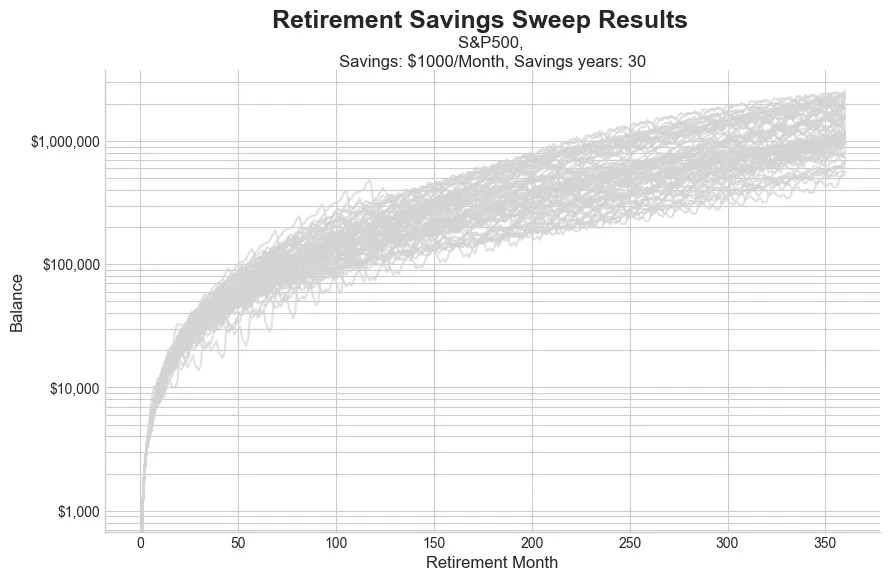
S&P 500 30-Year Savings Accumulation Trajectories ($1,000/Month): Simulating $1,000/month saved over 30 years in the S&P 500 reveals a 5.04x luck spread between the worst cohort ($0.53M, 1952) and best cohort ($2.66M, 1970), with a historical median of $1.24M.
The chart above is the result of simulating 30 years of saving $1000/month, savings are being invested in the S&P500, where savings start in each year from 1929-1996. Each line represents the savings growing over the 30 years for each potential savings starting year from 1929-1996. Note that real returns (inflation adjusted) are used to keep dollar value constant for all years.
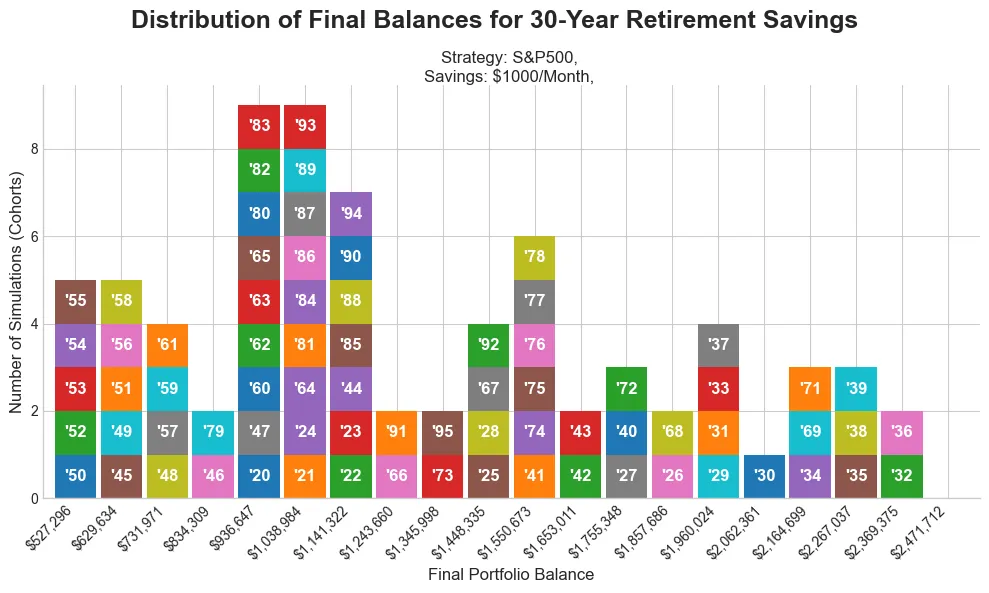
Distribution of Final Balances for 30-Year Retirement Savings (S&P 500): Year-block stacked histogram categorizing historical 30-year S&P 500 final balances: starting savings in 1950–1955 yielded the lowest returns ($528K–$662K), whereas late-1930s and 1970 starts yielded $2.02M–$2.66M.
The chart above is a histogram of those returns, with the savings starting year shown in each histogram box. I.E. On the left we see savings starting in the years 1950, 1952-1955 had the lowest performance, with final savings balances for those years between $528K - $662K.
Conversely, the late 1930s and 1970 were great times to start saving, with years 1932, 1935, 1936, 1938, 1939, and 1970 resulting in final savings balances ranging from $2.02M to $2.66M.
The constant return analysis showed a final savings balance of $1.21M.
Using actual historic returns shows final balances ranging from $528K - $2.66M, with a mean of $1.38M and median of $1.24M.
Following the same savings methodology, the luckiest cohort wound up retiring with 5.0 times more money than the most unlucky ($2.66M / $528K = 5.04x multiplier).
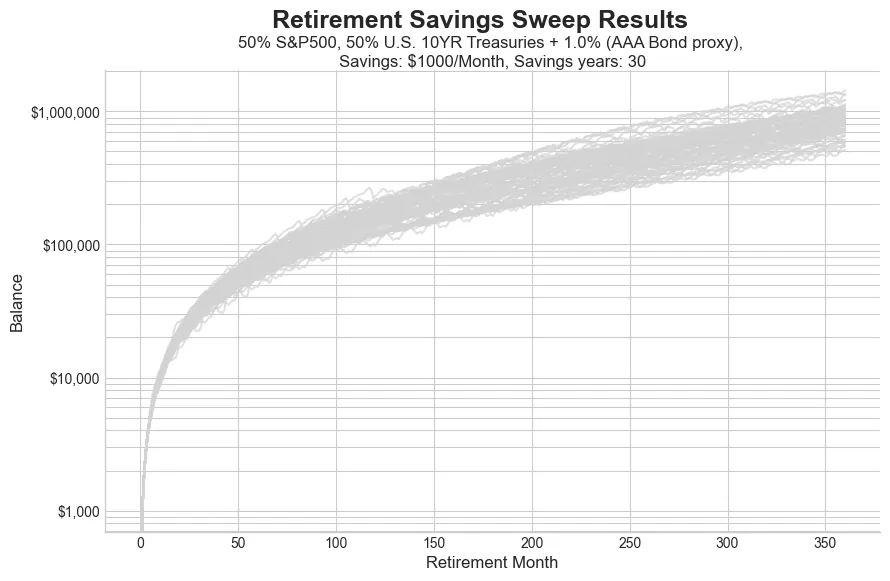
50% Stocks / 50% Bonds 30-Year Savings Accumulation ($1,000/Month): A 50/50 stock/bond portfolio reduces overall volatility and caps top-end upside ($1.66M vs $2.66M), while delivering a median final balance of $0.87M.
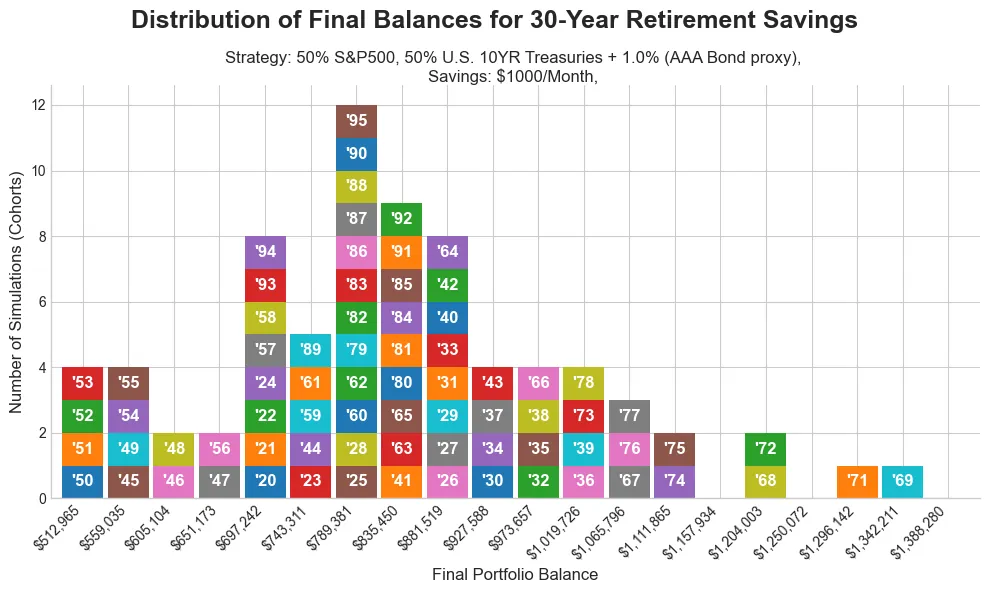
Distribution of Final Balances for 30-Year Retirement Savings (50/50 Mix): Stacked year-block histogram for 50/50 stock/bond allocation demonstrates how adding 50% bonds compresses outcomes toward the center ($0.87M median vs $1.24M S&P 500 median), reducing maximum upside while maintaining a similar lower-bound floor.
This is a repeat of the analysis above, but now assuming the money is invested in a mix of 50% S&P500 and 50% investment grade corporate bonds.
Using actual historic returns with a mixed portfolio shows final balances ranging from $343K - $1.66M, with a mean of $930K and median of $874K.
Interestingly, while the general results (mean, median, maximum) were higher for an all-stock portfolio, both asset allocations experience significant sequence drag during historically unfavorable entry cohorts.
Takeaways
It's important to always keep in mind that while a given portfolio has a long term average return, the following apply:
Past results are not indicative of future results
Your mileage may vary
Fundamentally, don’t just assume you will get the average return for any given index or portfolio. History is long, but our lives are not; plan for outcomes substantially different than average.
Watch the Video Summary
Prefer video format? Watch the summary on our dedicated player page (6:21).
Assuming a historical 7% real (inflation-adjusted) return, investing $1,000 every month for 30 years will accumulate to roughly $1.2 million in today's purchasing power, demonstrating the incredible power of compound interest.
If started early enough (e.g., in your 20s or early 30s) and invested in broad-market index funds, $1,000 a month is mathematically sufficient to build a multi-million dollar portfolio by standard retirement age. However, starting later will require much larger monthly contributions.
The Rule of 72 is a quick mental math shortcut. Divide 72 by your expected annual return to find out how many years it will take for your money to double. For example, at a 7% return, your money doubles roughly every 10 years (72 / 7 = 10.2).
The rule is derived from the compound interest formula. To calculate the exact time it takes an investment to double, you solve for time using the natural logarithm of 2, which is 0.693. This means it technically takes 69.3 divided by your interest rate to double your money. The number 72 is used instead of 69.3 simply because it is easily divisible by many common numbers (2, 3, 4, 6, 8, 9, 12), making mental math much easier while remaining highly accurate.
Paul Dunn applies software engineering and data analysis principles to retirement planning. As a data engineer, he designs quantitative simulators (Monte Carlo, SWR sweep, tax optimizers) to verify portfolio longevity against historical and statistical cycles.
View Video Transcript
You know, so many of us share this common goal, right? We save for decades trying to build up enough to have a really comfortable retirement. We punch numbers into those online calculators. They spit out a nice neat target number and we aim for it. But what if I told you that one of the biggest, and I mean biggest factors in how much you end up with is something you have absolutely zero control over. Today, we're going to dig into the wild, surprising role that pure, simple luck plays in your retirement. So, let's start with a really straightforward question. Imagine you are super disciplined. You save $1,000 every single month for 30 years straight. No exceptions. Does that make you a millionaire? You know, the common wisdom and a lot of the tools you find online, they'd have you believe the answer is a simple resounding yes. But as we're about to see, the real answer is, well, it's a whole lot messier than that. So, first, let's just look at that simple promise. The one that assumes everything is smooth sailing, a nice predictable journey to becoming a millionaire. Okay? So, if you assume a constant steady return of 7% a year after inflation, which is a pretty common benchmark people use, then yeah, after 30 years of tucking away a grand a month, you'd end up with a cool 1.2 million bucks. It's clean, it's encouraging, and honestly, it's the number that a whole lot of financial advice is built on. But here's the thing, and we all know this intuitively, right? The market doesn't just hand you a neat 7% every year like clockwork. Oh, no. It zigs, it zags, it booms, and then it busts. And all that messiness, that volatility, it completely changes the game. And this brings us to the absolute heart of the matter. The massive role that pure luck plays in all this. It's not just about how much you save. It turns out it's just as much about when you happen to be saving it. All right, take a look at this. It might look like a plate of spaghetti, but what you're seeing is a historical simulation. Every single one of those gray lines, that's a person saving $1,000 a month for 30 years invested in the S&P 500. The only thing that's different between all of them, the year they started saving. It's just incredible. This chart shows some people just barely squeaking over the million-dollar line, while others are way, way up there, all for following the exact same plan. So, let's try to unpack these crazy results a little more. We'll start by focusing on this all stock portfolio. You know, the high-risk, highreward approach. Now, this is where it gets really fascinating. This chart organizes all that chaos. It's what's called a histogram, and it shows the final portfolio balances. And see those little numbers in the boxes? Those are the start years for each 30 years saving journey. You can see it right away. Look at the far left. Those are the unlucky savers, the folks who happen to start in the early 1950s. And then look all the way to the far right. Those are the luckiest ones who had the incredible good fortune to start saving in the late 1930s. And the difference between them is just staggering. I mean, the unluckiest saver, who did everything right, followed the plan to a te and did their 30 years with just $527,000. Meanwhile, the luckiest saver, following the identical strategy, retired with over $2.4 million. Wow. Let me just put that another way so it really sinks in. The luckiest person ended up with 4.6 times more money than the unluckiest person. Think about that. same savings, same discipline, same investment. The only difference was a different roll of the dice on what year they happen to be born and start their career. So, if going allin on stocks is such a roller coaster, what about playing it a little safer? You know, can we tame some of that wildness by diversifying a bit? Let's see what happens. So, to test this, the source material ran the exact same simulation, but this time with a more conservative portfolio. It's a classic, a 50/50 split. half your money in stocks, the other half in highquality corporate bonds. The whole idea here is that the bonds are supposed to smooth out the ride when the stock market gets choppy. And this sideby-side comparison just illustrates the effect perfectly. On the left, you've got the all stock portfolio we were just looking at. On the right, the new 50/50 portfolio. You can see it immediately, right? The results on the right are much more bunched up. Those crazy multi-million dollar wins are gone, but all the outcomes are a lot more clustered together in the middle. Okay, let's put some hard numbers to that. So, yeah, diversifying it did exactly what you'd think. It lowered the ceiling. The absolute best case scenario dropped from 2.4 million down to 1.4 million. The median or kind of the typical outcome also fell from over 1.2 million to about $843,000. But, and this is the real kicker, look at the worst case scenario, it barely moved. The unluckiest all stock saver ended up with $527,000. the unluckiest 50/50 saver. They ended with $513,000. So, playing it safe didn't really save you from the absolute worst luck of the draw. So, what in the world is the takeaway here? I mean, if even a safer strategy can't totally protect you from a bad roll of the dice, how are we supposed to approach planning for our own retirement? Well, it really brings two of the oldest warnings in finance into sharp focus. You've heard them a million times. Past results are not indicative of future results. And my personal favorite, your mileage may vary. This historical data, it isn't a crystal ball. Think of it more like a map that shows the huge, huge range of possible destinations you could end up in, even if you follow the exact same road as everyone else. And that leads us to what is probably the single most important lesson from all of this. Don't don't anchor your entire financial future to a single average number that a calculator spits out. History shows us that our saving careers are, you know, relatively short and the 30 years we get might not look anything like the long-term market average. So, the crucial thing is this. Plan for a range of outcomes. Yeah, hope for the best, but you have to prepare for outcomes that could be substantially different and maybe a lot lower than the average. Because when it's all said and done, the only thing you can truly control is how you plan for that uncertainty.
Disclaimer
For Educational Purposes Only: All content on this site, including articles, tools, and simulations, is for informational and educational purposes only. It should not be construed as financial, investment, legal, or tax advice. The information provided is general in nature and not tailored to any individual's specific circumstances.
Software Development & Data Processing Risks: The software used to perform the analyses may have errors or inaccuracies. When we post updates to any material, errors or inaccuracies that are subsequently fixed may change the results. Historical pricing revisions, corporate actions, or algorithmic optimizations may dynamically recalculate past simulation timelines. As a result, past signal sequences shown on this site or in digests may shift retroactively to align with the revised data.
No Guarantees & Risk of Loss: The analyses and simulations presented are based on historical data. Past performance is not an indicator or guarantee of future results. All investing involves risk, including the possible loss of principal. Market conditions are subject to change, and the future may not resemble the past.
No Fiduciary Relationship: Your use of this information does not create a fiduciary or professional advisory relationship. We are not acting as your financial advisor.
Consult a Professional: You should always conduct your own research and due diligence. Before making any financial decisions, it is essential to consult with a qualified and licensed financial professional who can assess your individual situation and objectives. We disclaim any liability for actions taken or not taken based on the content of this site.
Data Sources & Attribution: This site utilizes the FRED® API provided by the Federal Reserve Bank of St. Louis. This product uses the FRED® API but is not endorsed or certified by the Federal Reserve Bank of St. Louis. All FRED® data is used strictly for internal analytical processing and research.
Third-Party Links & Endorsement: This site contains links to third-party websites and resources for your convenience. We have no control over the content, privacy policies, or practices of these sites. The inclusion of any link does not imply endorsement, sponsorship, or recommendation by Algorithmic Fire LLC. We are not affiliated with any third-party sources unless explicitly stated, and we disclaim any liability for information or services provided on these external platforms.
Regulatory Status: Algorithmic Fire LLC is not a registered investment adviser, broker-dealer, or financial planner, and is not affiliated with the Securities and Exchange Commission (SEC) or the Financial Industry Regulatory Authority (FINRA). The content, tools, and simulations provided on this site do not constitute, and should not be construed as, professional financial advisory services.
Copyright 2025-2026 Algorithmic Fire LLC. All rights reserved.