📌 Summary & Key Takeaways
- Starting Higher Does Not Work Because Failures Happen Early: Starting with a 5.5% withdrawal rate instead of a variable strategy exposes the portfolio to failure in the same early inflation and crash regimes that have historically caused SWR failures. Variable strategies work because they respond to performance rather than committing to a fixed withdrawal level through bad periods.
- The SWR Curve Creates a Natural Ratchet Mechanism: Once a portfolio has survived 10 years at 4% SWR, the remaining retirement horizon is shorter — and a shorter horizon supports a higher withdrawal rate with the same safety. A portfolio that started at 4% and grew past year 10 can support 5–6% withdrawals on the remaining balance, effectively raising real income without raising failure risk.
- Below 3.5%, a Portfolio Can Sustain Withdrawals Indefinitely: At a withdrawal rate of ~3.5% or less (50% stock / 50% investment-grade bond portfolio), historical simulation across 5,000 Monte Carlo runs shows near-zero long-term failure probability. The portfolio compounds faster than the withdrawal depletes it in most regimes.
We’ve covered the 4% Rule in our post Understanding Safe Withdrawal Rate. The 4% Rule is one example of a Fixed Safe Withdrawal Rate. (“Fixed” refers to the fact that the withdrawal rate is fixed in terms of real dollars; or dollars of constant purchasing power. The withdrawals are allowed annual inflation adjustment.)
The 4% Rule (revised to the 4.5% Rule) has since been built upon by various other strategies that involve variable rates. (I will be publishing an extensive post on different strategies shortly.)
A question this often raises is, “Why vary the withdrawal rate? Why not just start with a higher withdrawal rate?”.
In our post Safe Withdrawal Rate Failure, we showed how failures generally happen during prolonged periods of low or no real returns. (Where “real return” here means inflation adjusted return, as opposed to nominal return.) That implies that the longer a retirement is designed to last, the higher the probability of encountering such a period.
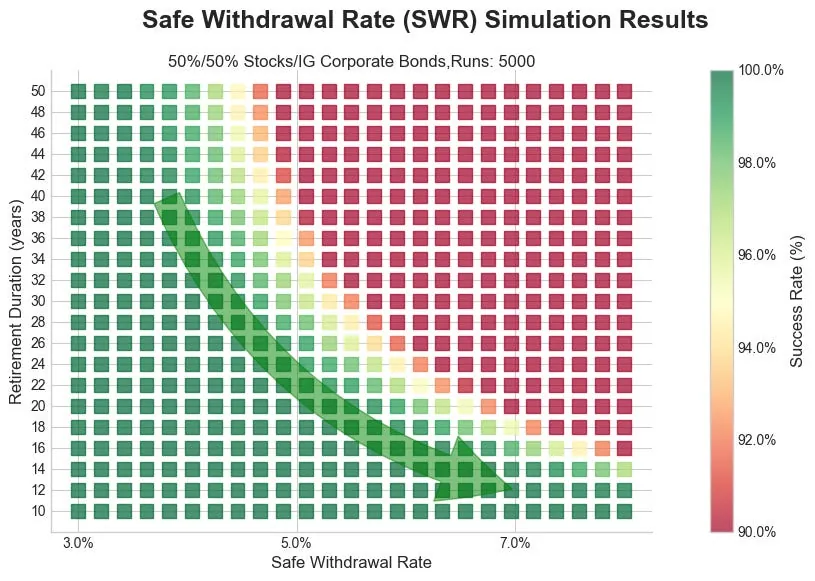
We’ve modeled a fixed safe withdrawal rate, using a portfolio of 50% stocks and 50% investment grade corporate bonds, for durations of 10 to 50 years. The model is a statistical (Monte Carlo) model that uses 5000 runs at each duration and withdrawal rate. The success rate was recorded and charted below.
-
The green arrow shows a path of decreasing years in retirement.
-
Early on, the slope of the arrow is quite steep, indicating any increase in withdrawal rate comes with high risk.
-
Later on, the slope of the arrow is quite shallow, indicating withdrawal rate can be increased rapidly without taking on increased risk.
-
-
If you have enough money to live on about 3.5% or less of the portfolio, your retirement can last indefinitely. You will likely pass money on when you pass.
- For a retirement shorter than 10 years, you can use a relatively high withdrawal rate; up to about 8%.
It’s the nature of this curve that enables variable withdrawal rate strategies to work. Once you have succeeded at a given withdrawal rate, your remaining retirement years move you lower, and into yet safer (more green) space. Once well into safe space, you can then move right and increase your withdrawal rate while still staying at or near 100% predicted success.
Another mechanism that enables higher withdrawals later in retirement is that once you have survived early Sequence of Return Risk, there is a possibility that you will have excess funds. The compounding of those excess funds can also enable higher than initially planned withdrawals, as the higher balance effectively reduces withdrawal rate.
If you want to go deeper — comparing Fixed, Percent of Portfolio, and Variable withdrawal strategies — I cover all three in detail in The 4% Rule Is Dead. Here's What's Replaced It.