U.S.-Based Investors Think the Worst-Case Scenario is the Great Depression or GFC. Other Countries Disagree.
When investment planning for retirement, it is important to consider all possible outcomes. We take a look at Japan in the 1990s to redefine "worst case".
U.S. Data Creates a Dangerous Survivorship Bias: Standard 4.0% SWR safety rules rely exclusively on U.S. historical data, where no 30-year cohort failed a 50/50 allocation. Assuming the U.S. will always avoid long-term structural stagnation ignores major developed-market precedents.
Japan's 34-Year Stagnation Redefines Sequence Risk: The Nikkei 225 peaked in December 1989 at ¥38,915 and required 34 years (until February 2024) to recover nominally — and until late 2025 in real inflation-adjusted terms. For 28 years, the index averaged just 39.6% of its peak value.
A Japanese Equity Portfolio Required a 2.0% SWR to Avoid Ruin: A retiree starting in 1985 (enjoying a massive 237% bull run before the crash) ran out of money in 19 years at a 5.0% SWR and 26 years at a 3.0% SWR. Only reducing withdrawals to 2.0% SWR enabled portfolio survival across a 30-year horizon.
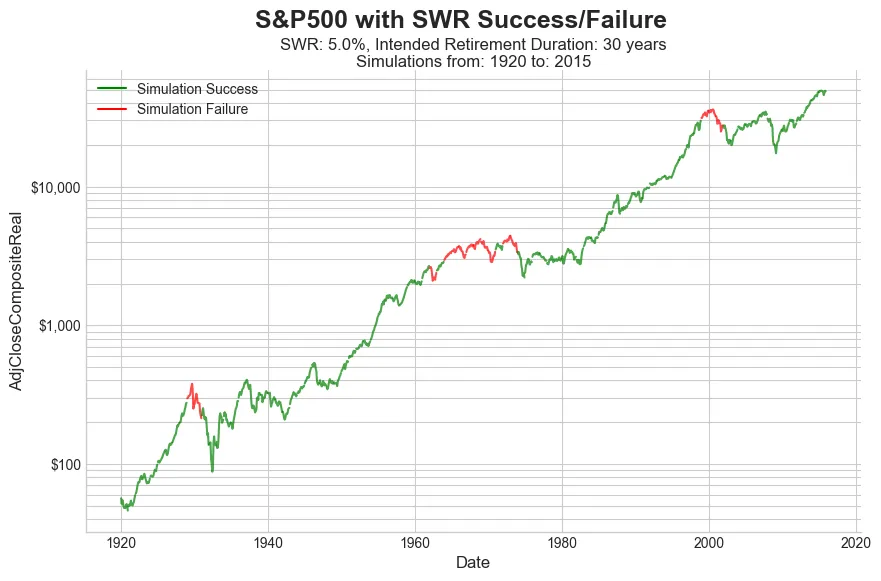
U.S.-based investors have had it quite good, for a long time. As we showed in our post “Safe Withdrawal Rate Failure”, using a fixed Safe Withdrawal Rate (SWR) of 5% and a 50%/50% stocks/bonds allocation failed across several historical market shock periods (such as 1937, 1962–1969, and 1973).
If you had used a 4.5% SWR with the same portfolio, there were zero failures.
S&P 500 50/50 Portfolio Real Return & 5.0% SWR Failure Cohorts: Historical S&P 500 50/50 portfolio decumulation. Under a 5.0% SWR, multiple historical cohorts failed across 30-year horizons (including 1937, 1962–1969, 1973, and others).
Even if you were 100% stocks with a 5% SWR, there were only a few more failing years. (See above chart.) This has left U.S.-based investors confident in general, and confident in U.S. stocks in particular.
This historical data, or statistics derived from it, are used in models to determine Safe Withdrawal Rates. Thus the 4% Rule, now the 4.5% Rule, doesn’t fail against the prescribed 50/50 (stock/bond) portfolio. But does this data really represent a proper range of scenarios, including worst case?
It can be worse - Japan in the 90s
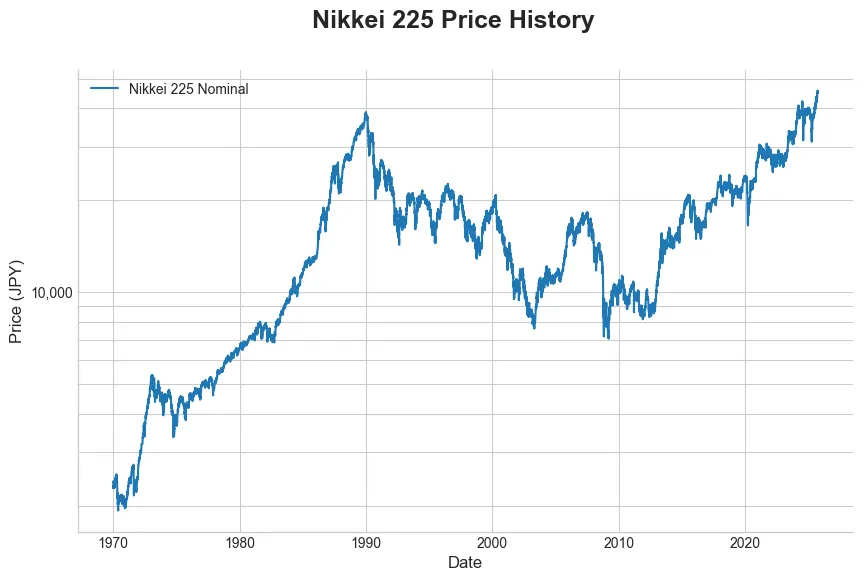
Nikkei 225 Price History (1970 – Present): Nikkei 225 index history (1970–present). Peak at ¥38,916 in Dec 1989 required 34 years to recover nominally (Feb 2024), illustrating extreme structural stagnation risk.
The chart above shows the Nikkei 225 (JAN 1970 - SEP 2025). The Nikkei 225 is roughly the Japanese equivalent of the S&P 500, as it is the most prominent stock index tracking major Japanese companies on the Tokyo Stock Exchange, serving as a key economic barometer. (The Nikkei 225 and S&P 500 differ significantly in calculation as the Nikkei 225 is price-weighted, while the S&P 500 is market-cap weighted.)
The obvious problems:
The index peaked in December 1989 at ¥38,915, and didn’t see that level again until February 2024.
The chart is nominal price; not inflation adjusted. That 1989 level represents about ¥47K in today's Japanese Yen. Thus, in real terms, the index only regained its 1989 peak in October 2025.
From 1/1992 to 1/2020, the index averaged ¥15,395, or 39.6% of its peak.
It reached a post-bubble low of ¥7,055 (March 2009), or 18.1% of its peak.
Retirement Scenario Results
🔒
Premium Members Only
The full analysis — trade logs, interactive charts, and quantitative risk breakdowns — is available to Premium subscribers. Already a member? Log in to continue reading.
Historically, US investors view the Great Depression or the 2008 Global Financial Crisis as worst-case scenarios. However, looking internationally, other countries have experienced far worse outcomes, including total market wipeouts, hyperinflation, and geopolitical destruction, highlighting the importance of global diversification.
While the US stock market has dominated for the last century, holding only US stocks exposes you to 'single-country risk.' International diversification ensures that if the US experiences a multi-decade stagnation (like Japan in the 90s), your portfolio continues to grow.
Research by Wade Pfau and others has shown that the 4% rule is an American anomaly. If you run the 4% rule against the historical data of almost any other developed nation, it fails spectacularly due to wars, hyperinflation, and market collapses.
Paul Dunn applies software engineering and data analysis principles to retirement planning. As a data engineer, he designs quantitative simulators (Monte Carlo, SWR sweep, tax optimizers) to verify portfolio longevity against historical and statistical cycles.
View Video Transcript
Today we are going to talk about one of the holy grails of retirement planning, the 4% rule. For millions of people, it's the go-to rule for financial advice. But what if its entire foundation is built on a uniquely American success story that well might not hold up everywhere else? So, let's just jump right in with a big question. We all rely on history to plan for our future, right? But what if the history we're all using isn't really the worst case scenario. What if a much much tougher reality is possible even in a modern advanced economy like our own? Okay, so first let's talk about why this rule is so popular in the United States. Retirement planning models feel incredibly solid, almost foolproof. And that's because they're based on about a century of data that tells a very, very comforting story. And just look at this chart. You can see just how safe things look. This shows a 5% withdrawal rate simulated against almost 100 years of S&P 500 performance. And you see all that green? That means the retirement plan worked. You only see these tiny little specks of red where it failed. It gives you a real sense of security, doesn't it? And you know what? If you dial it back just a little bit, get a little more conservative, the picture gets even better. Drop that withdrawal rate to 4.5% and poof, the red just disappears. Based on US history, a 4.5% rule has a perfect 100% track record. It's like the ultimate security blanket for American retirees. But this is where we have to pump the brakes and ask a really important question. That whole feeling of safety is based entirely on the experience of one single country. A country whose history is defined by resilience, recovery, and an almost unstoppable upward march. So, is the American market with its incredible V-shaped recoveries from every single crash really the right benchmark for a plan that needs to survive anything? Or is it possible that US investors have just been really, really lucky? To figure that out, we need to look somewhere else. And that somewhere else is Japan. Starting around the 1990s, the Japanese market gives us a chilling counternarrative. It's a real world stress test that absolutely shatters some of our most basic assumptions about investing. And wow, this image just says it all, doesn't it? On the left, you've got the S&P 500. Sure, there are dips and crashes, but they're always followed by a powerful recovery to new highs. But on the right, that's Japan's NIK 225. It hits this unbelievable peak in 1989 and then it falls into a black hole for decades. There's no quick comeback. There's just nothing. And just so we're all on the same page here, the NICA25 is basically Japan's version of the S&P 500. It's the big one, the main index that tracks Japan's largest companies. Think about this for a second. Over 35 years, a full generation. That's how long it took for the NICA to get back to its 1989 peak after you account for inflation. A standard 30-year retirement plan wouldn't have even been long enough to see the recovery. And the crash itself was just savage. At its absolute lowest point, the index wasn't just down. It was practically wiped out. A staggering 82% below its peak. Just gone. Now, this wasn't a quick dip in recovery. For almost 30 years, from 1992 all the way to 2020, the index just sat there averaging only 39% of its old peak value. Can you imagine your retirement portfolio spending 28 years at less than half of what you started with? So, what would this actually feel like for a real person trying to retire? Let's run a little simulation and see what happens when a standard retirement plan runs headirst into a realworld catastrophe. And we're not even going to pick a bad time to retire. In fact, let's pick a perfect time. Let's say you retire in 1985. For the first 5 years, you're a genius. The market is on an absolute tear and your portfolio more than triples. You are feeling invincible. You literally couldn't ask for a better start. But then the bubble bursts and the results are just devastating. A 5% withdrawal rate. Your money is completely gone in 19 years. Okay, so what about a super safe 3% rate? Nope. You still run out of money in year 26. Only by dropping your withdrawals to a tiny 2% would you have barely scraped by for 30 years. Just let that sink in for a minute. A 2% withdrawal rate. That completely flips the script on how much you need to save. It basically means you need a nest egg twice as big as what the 4% rule tells you. All because the market never came back within a single human lifetime. So, what are the big lessons we can pull from this uh pretty sobering story? Japan's lost decades offer some really powerful, if uncomfortable, takeaways for anyone planning for the future. You know, a lot of the common investing advice we hear all the time would have led you straight to disaster. Buy the dip in Japan. That was like trying to catch a falling chainsaw for 20 years straight. Valuations don't matter. Yeah, that was the exact thinking that fueled the bubble in the first place. And buy and hold, it works, but only if the long term is longer than your actual retirement. And if you need any more proof of just how disconnected from reality things got, get this. At the peak of the bubble, the grounds of the Imperial Palace in Tokyo, just a small patch of land, were supposedly worth more than all of the real estate in the entire state of California. I mean, come on. That's the definition of insanity. So, let's boil this all down. What do we need to remember? First, not every dip is a gift from the market gods. Second, valuations always matter eventually. Third, your 30-year retirement might not be long enough for a long-term market cycle to play out. And maybe the most important lesson of all, we have to accept that these devastating multi-deade collapses can happen even in the most successful economies in the world. Which leaves us with one last pretty heavy question to think about. Look, the Japanese experience might be an outlier, an extreme case. But retirement planning isn't about preparing for the average day. It's about making sure you can survive the absolute worst day. So, does your plan account for a real decadesl long catastrophe? Or is it just planning for a temporary Americanstyle downturn?
Disclaimer
For Educational Purposes Only: All content on this site, including articles, tools, and simulations, is for informational and educational purposes only. It should not be construed as financial, investment, legal, or tax advice. The information provided is general in nature and not tailored to any individual's specific circumstances.
Software Development & Data Processing Risks: The software used to perform the analyses may have errors or inaccuracies. When we post updates to any material, errors or inaccuracies that are subsequently fixed may change the results. Historical pricing revisions, corporate actions, or algorithmic optimizations may dynamically recalculate past simulation timelines. As a result, past signal sequences shown on this site or in digests may shift retroactively to align with the revised data.
No Guarantees & Risk of Loss: The analyses and simulations presented are based on historical data. Past performance is not an indicator or guarantee of future results. All investing involves risk, including the possible loss of principal. Market conditions are subject to change, and the future may not resemble the past.
No Fiduciary Relationship: Your use of this information does not create a fiduciary or professional advisory relationship. We are not acting as your financial advisor.
Consult a Professional: You should always conduct your own research and due diligence. Before making any financial decisions, it is essential to consult with a qualified and licensed financial professional who can assess your individual situation and objectives. We disclaim any liability for actions taken or not taken based on the content of this site.
Data Sources & Attribution: This site utilizes the FRED® API provided by the Federal Reserve Bank of St. Louis. This product uses the FRED® API but is not endorsed or certified by the Federal Reserve Bank of St. Louis. All FRED® data is used strictly for internal analytical processing and research.
Third-Party Links & Endorsement: This site contains links to third-party websites and resources for your convenience. We have no control over the content, privacy policies, or practices of these sites. The inclusion of any link does not imply endorsement, sponsorship, or recommendation by Algorithmic Fire LLC. We are not affiliated with any third-party sources unless explicitly stated, and we disclaim any liability for information or services provided on these external platforms.
Regulatory Status: Algorithmic Fire LLC is not a registered investment adviser, broker-dealer, or financial planner, and is not affiliated with the Securities and Exchange Commission (SEC) or the Financial Industry Regulatory Authority (FINRA). The content, tools, and simulations provided on this site do not constitute, and should not be construed as, professional financial advisory services.
Copyright 2025-2026 Algorithmic Fire LLC. All rights reserved.